How to Find a Reputable Ragdoll Breeder (2026 Buyer’s Guide)
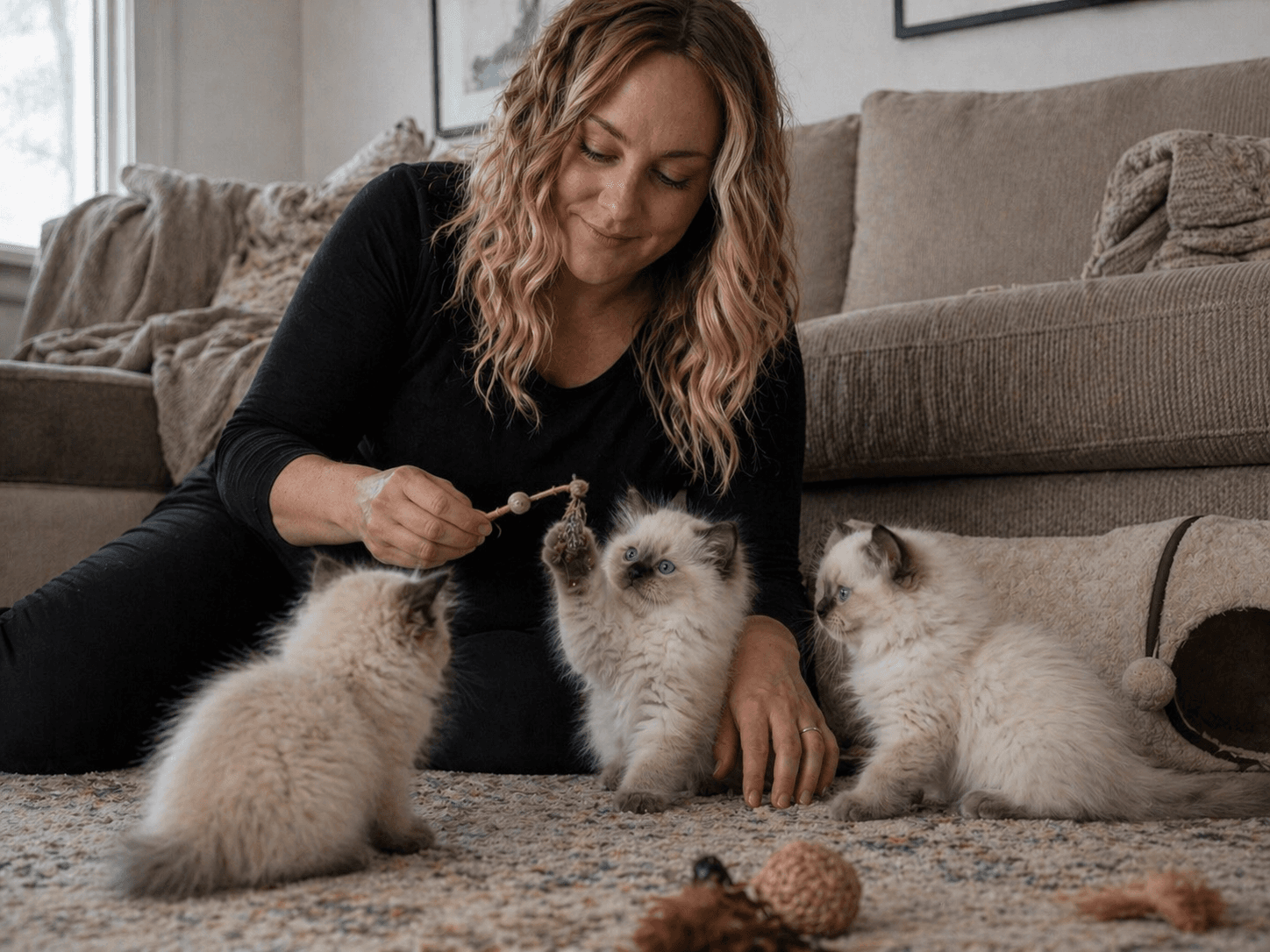
Choosing a Ragdoll breeder starts with information you can verify. A beautiful photograph is a lovely introduction, but it cannot tell you how a kitten is raised, what care has been completed, or who will support your family after homecoming. If you’re shopping for a Ragdoll kitten, knowing how to spot a reputable breeder isn’t optional — it’s essential.
This guide walks you through everything you need to evaluate before sending a deposit: credentials to verify, questions to ask, red flags to watch for, and what an ethical breeder relationship actually looks like.
Why This Matters More Than You Think
A Ragdoll kitten is a 12-17 year commitment. The breeder you choose shapes that experience profoundly:
- Health. Ask to read the breeding cats’ genetic reports and discuss HCM screening, including echocardiograms. DNA testing looks for particular variants; it is not a promise that a cat can never develop disease. UC Davis explains what the Ragdoll HCM genetic test detects.
- Temperament. Reputable breeders socialize kittens carefully — handled daily from birth, exposed to household sounds, introduced to gentle visitors. Backyard kittens raised in cages or barns are often skittish, fearful, or undersocialized.
- Support. A real breeder is a lifetime resource. They take their cats back if your situation changes. They answer the panicked midnight text about your cat throwing up. They are part of your Ragdoll’s life.
- Money. A “deal” kitten from a backyard breeder often costs more than an ethical breeder’s price once you factor in the avoidable vet bills.
The right breeder is the single most important decision you’ll make in your Ragdoll journey. Take it seriously.
What “Reputable” Actually Means
The word gets tossed around a lot, so let’s define it concretely. A reputable Ragdoll breeder:
- Is registered with a recognized cat fancy organization — TICA (The International Cat Association) or CFA (Cat Fanciers’ Association)
- Health-tests their breeding cats genetically (at minimum HCM and PKD)
- Raises kittens in a clean home environment, not cages or kennels
- Provides a written contract and health guarantee
- Is transparent about pricing, process, and what’s included
- Asks you questions before agreeing to sell you a kitten
- Stays in touch for the lifetime of your cat
- Has a real, traceable identity — not just a slick website
- Limits how many litters they produce per year
- Takes back any kitten or cat they’ve placed if you can no longer keep them
If a breeder fails on more than one or two of these points, keep looking. The good ones exist. They’re worth waiting for.
The 10 Questions Every Reputable Breeder Should Be Able to Answer
Print this list. Bring it to every breeder conversation. The right answers will come easily; the wrong ones will dodge, deflect, or contradict.
1. Are you registered with TICA or CFA?
Right answer: Yes, with their cattery name, and they can show you their registration paperwork.
Red flag: “I’m registered with [obscure registry you’ve never heard of].” Many fake registries exist purely to give scam catteries an air of legitimacy. TICA and CFA are the gold standards in North America.
2. Do you health-test your breeding cats?
Right answer: Yes — at minimum HCM and PKD, ideally a full genetic panel through Optimal Selection Feline or similar. They can show you the test results.
Red flag: “My cats are healthy, I haven’t needed to test them.” Visual health is not the same as genetic clearance. Ask which variants were tested, which cat each report belongs to, and when heart screening was performed. A genetic result is not an echocardiogram, and inheritance is not the same as a diagnosis in every kitten. NC State notes that even a Ragdoll negative for the tested HCM mutation may develop HCM.
3. Can I see where the kittens are raised?
Right answer: A virtual tour is standard practice (in-person visits often happen later in the process for biosecurity reasons). They should show you the actual room or space where kittens grow up.
Ask more questions: A meeting point can be a practical travel arrangement, but it should not be your only opportunity to verify the breeder and learn how the kittens are raised. Agree on the plan, see current kittens and their environment through an arranged visit or live video, and review the records before committing.
4. What’s included with the kitten?
Right answer: Spay/neuter surgery, age-appropriate vaccinations, microchip, deworming, TICA paperwork, a written contract, a health guarantee (typically 1 year for genetic conditions), and ideally a starter kit with food and bedding.
Red flag: “Spay/neuter is on you.” Reputable breeders include this because it protects the breed’s bloodline and ensures kittens go to pet homes only, not unauthorized breeders.
5. What’s your health guarantee?
Right answer: A written guarantee covering genetic conditions for at least one year, with clear terms about what’s covered and what isn’t.
Red flag: “Cats are sold as-is” or “no guarantee” or vague verbal assurances. If it isn’t written down, it doesn’t exist.
6. How early can the kitten go home?
Right answer: Around 12 weeks, and the breeder should be able to explain why. Ragdolls develop more slowly than many breeds, and the weeks between eight and twelve are when a kitten learns to be a confident adult cat. Most careful breeders place at around twelve weeks, after early spay/neuter and veterinary clearance — and some hold a kitten back a little longer if it needs the time.
Red flag: “Kittens go home at 8 weeks” or “ready to leave whenever you want them.” A kitten offered at eight or nine weeks hasn’t finished the part of growing up that only littermates can teach — and a breeder who can’t explain why they place at the age they do is telling you something too.
7. Can I talk to past adopters?
Right answer: Yes — they can connect you with families who’ve adopted from them, or point you to public testimonials and reviews.
Red flag: “I respect my buyers’ privacy” used as a deflection. Privacy is real, but a breeder placing dozens of cats has at least some adopters happy to talk about their experience.
8. What happens if my situation changes and I can’t keep the cat?
Right answer: “We take the cat back. Always. Lifetime, no questions asked.” This is non-negotiable for an ethical breeder.
Red flag: “Once they leave, they’re yours.” Reputable breeders are responsible for every cat they bring into the world. A breeder who washes their hands at sale is not one you want.
9. How many litters do you produce per year?
Look for: A clear explanation of how many cats and litters the breeder cares for, how the queens recover, and how every kitten receives individual attention. The number alone does not establish the quality of a program.
Ask more questions: Can the breeder explain the age, care, socialization and placement plans for each litter? Availability by itself does not establish whether a breeder is responsible.
10. Why are you a breeder?
Right answer: They love the breed, they’re invested in improving it, they have a mentor or program lineage, and they can speak knowledgeably about the breed’s history and standards.
Red flag: “It’s a good business” or vague answers about loving cats. Responsible breeding is serious work. Ask how the program supports veterinary care, the breeding cats’ welfare and continued support for the kittens it places.
Red Flags That Should Stop You Cold
Some warning signs are too serious to ignore. If you see any of these, walk away immediately — no matter how cute the kitten.
Compare the price with documented care
Ask for an itemized explanation of what has been completed and what you will need to arrange after homecoming. A low price does not prove fraud, and a high price does not prove quality. At Kitten Around Ragdolls, every companion kitten is $4,500, with no discounts; our go-home guide explains what we include.
🚩 Pressure to send money via wire transfer, gift cards, or crypto
Pause if someone pressures you to use an unfamiliar payment arrangement before you can verify their identity, the kitten and the written agreement. Do not assume that a familiar payment service guarantees purchase protection. Ask for the breeder’s written payment terms and a receipt.
🚩 Refuses video calls before deposit
Arrange a live video conversation or an appropriate in-person visit so you can ask questions and see the current kitten. If the seller cannot offer a credible way to verify the kitten and their identity, pause before sending money.
🚩 Reuses photos found elsewhere online
Right-click any photo on a breeder’s site and run a Google reverse image search. A copied photo deserves a closer look. Breeders may legitimately use their own photos on several directories, so compare the source, name and context, then ask for current live video of the kitten.
🚩 Vague location or no physical traceability
“We’re in California” without a city. PO box only. No phone number. Refusal to confirm where they’re physically located. Real breeders are findable. They’re proud of their cattery.
🚩 Aggressive urgency tactics
“This kitten will be gone tomorrow if you don’t deposit today.” A reputable breeder wants the right home for their kitten, not the fastest one. Pressure tactics are sales tactics, not breeder tactics.
🚩 No application or screening process
If you can hand over money without filling out an application, answering questions about your home, or getting screened in any way — the breeder doesn’t care who’s getting their kittens. That tells you everything.
🚩 Won’t put anything in writing
Verbal promises mean nothing. Every reputable breeder has a written contract and health guarantee. If they “don’t do contracts” — they don’t have anything to stand behind.
How to Verify a Breeder’s Credentials
Once you’ve found a breeder you’re seriously considering, verify them before sending money. This takes 15 minutes and can save you thousands of dollars and tremendous heartbreak.
Check TICA registration
Ask for the registered cattery name and registration paperwork, then use the registry’s official resources to check anything you do not understand. TICA’s online breeder listings are paid advertisements, separate from cattery registration. Absence from that directory does not prove a breeder is unregistered, and a directory entry does not replace reviewing records and the agreement.
Reverse image search their kitten photos
Right-click any kitten photo on their website → “Search image with Google.” Compare where the photo appears and who originally published it. A breeder may use the same photo in their own directory listings; unexplained identities or conflicting kitten details need clarification. Ask for current live video.
Verify their physical address
Confirm the breeder’s actual city, identity and appointment arrangements directly. A home cattery may protect its residential address and may not have signs or cat enclosures visible from the street. A map can help with travel planning, but it cannot establish the quality of animal care.
Check reviews across multiple platforms
Don’t just read testimonials on their website. Search for reviews on Google Business, Facebook, breeder review forums, and Reddit. Look for patterns — both positive and negative. A breeder with only 5-star reviews on their own site and no presence elsewhere is suspicious.
Ask their veterinarian
Reputable breeders are happy to give you the name of their cats’ veterinarian. You can call the vet office directly to verify the cattery is a real client (vets won’t share medical details, but they’ll usually confirm if a breeder is an actual client of theirs).
Search court records and BBB
For larger purchases, a quick check on Better Business Bureau, your state’s licensing database, and small claims court records can reveal pattern complaints. This is overkill for most cases, but worth it if anything feels off.
What an Ethical Breeder Relationship Actually Looks Like
Beyond credentials and questions, here’s what working with a reputable Ragdoll breeder feels like in practice. Use this as your gut check.
Before you adopt
- You complete an application that asks meaningful questions about your home, lifestyle, and experience with cats
- The breeder asks you as many questions as you ask them
- There’s a wait — usually weeks or months for a specific litter
- You video chat to meet the kittens and the breeder before any money changes hands
- You receive a written contract clearly stating price, what’s included, the health guarantee, and what happens if you can’t keep the cat
- You’re given resources — feeding guides, kitten-proofing tips, what to expect — long before pickup day
At pickup or delivery
- The kitten is at least 12 weeks old, fully vaccinated for their age, microchipped, and spayed/neutered
- You receive TICA paperwork, vet records, and a contract
- The breeder spends time with you reviewing care guidelines and answering last-minute questions
- You leave with a starter kit — food, a blanket that smells like the breeder’s home, sometimes a toy
After you bring your kitten home
- The breeder follows up in the first few days, the first week, and the first month
- You can text them with questions — about feeding, behavior, health, anything — and get real answers
- If something goes wrong (illness, behavior issue, life change), they’re a resource and an advocate
- They want updates on your cat for years to come because they genuinely care how the kitten they raised is doing
That’s what reputable looks like. If your breeder isn’t operating this way, they aren’t the right one.
How Long Should You Expect to Wait?
Ask the breeder about current litters, their matching process and what happens if the right kitten is not available yet. Timing depends on the cats and the household match, so a general wait-time estimate is not a promise. Both a waitlist and a currently available kitten can be part of a responsible program. At KAR, an approved application and deposit hold your place in line; we choose together after you meet the kittens.
Choosing a Ragdoll Breeder Near the Bay Area or Silicon Valley
If you are searching from San Jose, Palo Alto, Menlo Park, Los Altos, Cupertino or Saratoga, compare the program behind the kitten as carefully as the distance. Ask where the cattery actually is, how you can meet the kittens, and which records you can review before your visit.
Our cattery is in Sacramento, and visits are by appointment. Our Bay Area and Silicon Valley Ragdoll guide explains meeting and matching, travel planning and homecoming for families in the region. We do not have a Bay Area branch. Check the current kitten profiles for availability rather than relying on an old directory advertisement, and arrange the details with Kiki before making travel plans.
About Kitten Around Ragdolls
If you’ve made it this far, here’s a brief introduction to us. Kitten Around Ragdolls is a TICA-registered Ragdoll cattery in Sacramento, California. We’re a home-based program, and we work hard to do this the right way:
- TICA registered, mentored by Stormi Nell
- All cats currently breeding in our program have completed genetic testing. Reports and pedigrees are linked on our Kings & Queens page. Young future breeding cats complete testing before breeding. Echocardiograms are completed for Bowie, Princess and Bandit, with the rest of our breeding cats in progress; we do not promise HCM-free cats.
- Kittens are raised in our home, cage-free, handled daily from birth
- Every kitten goes home at 12+ weeks, spayed/neutered, vaccinated, microchipped
- Written contract, 1-year genetic health guarantee, 30 days of free Trupanion insurance
- Lifetime breeder support — text us anytime, take cats back if you can’t keep them, ever
- Flat $4,500 pricing for every kitten — no upcharges for color, pattern, or “show quality”
If we sound like a good fit, we’d love to hear from you. Start your application here, or reach out with questions. And if we’re not the right fit — that’s okay too. The most important thing is that you find a breeder you can trust. Use this guide. Take your time. The right cat is out there.
Related Reading
- How Much Do Ragdoll Kittens Cost in California? (2026 Guide)
- Adopting a Retired Ragdoll: A Different Kind of Love Story
Kitten Around Ragdolls is a TICA-registered Ragdoll cattery in Sacramento, California, serving families across Northern California, the Bay Area, and nationwide via flight nanny. Owner Kiki Godfrey is mentored by Stormi Nell.
Recent Blogs
10/24/2026
Introducing a Ragdoll Kitten to Another Cat: Let Comfort Set the Pace
10/21/2026
Ragdoll vs. Birman: Similar Blue Eyes, Two Different Breeds
10/17/2026
Male vs. Female Ragdoll Cats: Choose the Individual, Not the Stereotype

10/14/2026
Can Ragdoll Cats Be Left Alone? Planning for Workdays and Real Life
10/12/2026
Buffy’s Ragdoll Lovers Giveaway: Win the Matching Blue Porcelain Set
10/10/2026
Do Ragdoll Cats Shed? A Grooming Routine That Fits Real Life
Subscribe to our newsletter
Kitten availability, cattery updates, and new blog posts — sent when we have news to share.