How to Read a Ragdoll Breeder’s Health Testing (What Documentation Should Actually Look Like)
How to Read a Ragdoll Breeder’s Health Testing (What Documentation Should Actually Look Like)
You’re evaluating a Ragdoll breeder. Their website says the cats are “fully health tested.” You ask to see the results. They send you a screenshot showing “HCM: N/N.”
Is that enough?
No. Not even close.
Real health testing documentation is specific, dated, and verifiable. Anyone can type “HCM: N/N” on a website. That doesn’t mean a test was ever done. And even when a test WAS done, “N/N” alone doesn’t tell you which test, which lab, when, or on which cat.
This post is your practical guide to reading what a breeder actually gives you — what should be there, what’s a red flag, and how to verify what you’re looking at.
The Two Kinds of “Health Testing” That Aren’t the Same
Before we get into documentation, one important distinction:
Genetic (DNA) testing is a one-time test that shows what genes a cat carries. It doesn’t change over time. It tells you what conditions the cat could develop or pass to offspring based on identified genetic markers.
Diagnostic testing (like echocardiograms) is a point-in-time assessment of what’s happening in the body right now. A clean echo at age 1 doesn’t guarantee a clean echo at age 5.
Ethical Ragdoll breeders do both — DNA tests for the conditions where we have reliable genetic markers, and periodic diagnostic testing for conditions like HCM that require ongoing monitoring even in genetically-negative cats.
If a breeder only shows you DNA test results with no diagnostic testing (or vice versa), that’s incomplete.
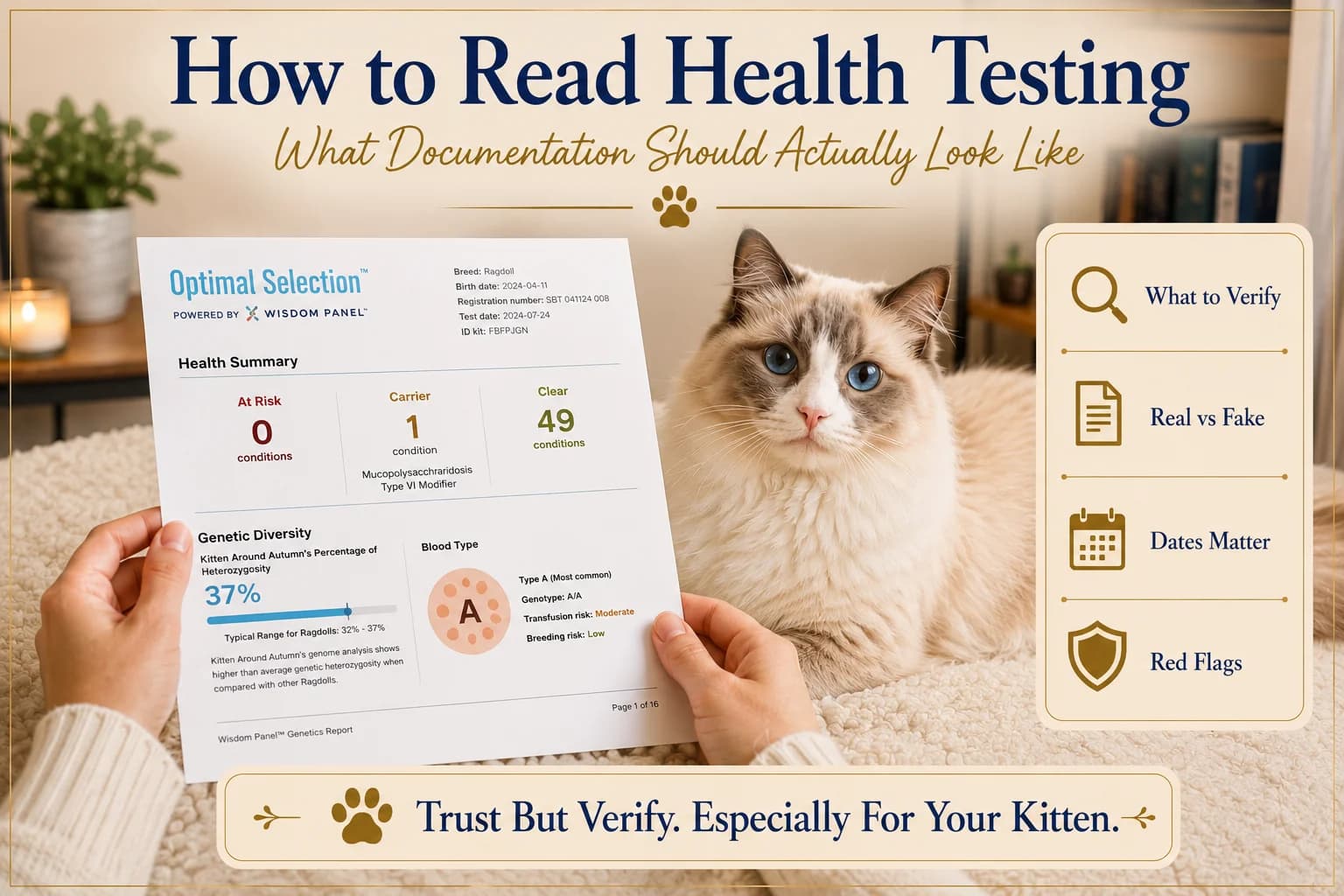
What a Real DNA Test Certificate Looks Like
A legitimate DNA test result from a lab like UC Davis VGL or Wisdom Panel includes:
- The lab’s official letterhead — logo, address, contact info
- The cat’s registered name (matching the pedigree, e.g., “Kittenaround [Cat Name]”) — NOT a nickname
- The cat’s microchip number — this is how the lab verified the sample came from that specific cat
- The date the sample was collected and the date results were issued
- The specific test name (e.g., “MYBPC3 R820W HCM” or “PKD1”)
- The result in context — not just “N/N” but explanation of what N/N means
- A certificate ID or reference number that can be verified back to the lab
- The lab technician or veterinarian’s signature or credentials
What you should NOT accept:
- A screenshot showing only “N/N” with no context
- A photo of a printed page with no lab letterhead
- A test result with no date
- A test result for a cat whose name doesn’t match the pedigree
- A summary the breeder typed themselves
- Anything that looks edited or altered
What a Real Echocardiogram Report Looks Like
A legitimate echo report from a board-certified veterinary cardiologist includes:
- The cardiologist’s name and credentials — should include “DVM” and “DACVIM (Cardiology)” or similar board certification
- The cardiology practice’s letterhead
- The date of the examination — critical because echoes are point-in-time
- The cat’s registered name and microchip number
- Specific measurements — left ventricular wall thickness, chamber dimensions, etc.
- An interpretation or diagnosis — usually something like “no evidence of hypertrophic cardiomyopathy at this time”
- Recommendations for follow-up — typically a recommendation for annual re-scanning
What you should NOT accept:
- “Our vet said the heart sounded fine” — this is auscultation, not echocardiography
- An ultrasound performed by a general practitioner instead of a board-certified cardiologist
- An echo report with no date
- An echo report older than 12-24 months for actively breeding cats
- An NT-proBNP blood test alone (this does not replace an echocardiogram)
The Dates on the Documents Matter More Than People Realize
Here’s a mistake many buyers make: they see health testing results and don’t check when the tests were done.
For DNA tests, dating matters less — genotype doesn’t change. A DNA test from 2022 is still valid in 2026.
For echocardiograms, dating matters enormously. A cat’s heart can develop HCM at any age. An echo report from three years ago tells you the heart was fine three years ago. It tells you nothing about the heart today.
For breeding cats, echo reports should be current — usually within the last 12 months per the PawPeds schedule for cats under age 3, and updated after that per your vet’s recommendation.
Ask breeders directly: “When was your cat’s last echo?” If the answer is “we did one before starting to breed” and that was several years ago, they’re not on the current standard of care.
How to Verify a Test Certificate
Some labs allow direct verification of certificates. For example, UC Davis VGL certificates typically include a certificate ID that can be verified back to their records.
If you suspect a certificate is edited or fraudulent, you can:
- Email the issuing lab and ask them to verify the certificate ID
- Compare the format to publicly-available sample certificates from that lab
- Check that the cat’s microchip number on the certificate matches what the breeder has told you
- Ask the breeder to have the lab email results directly to you
An ethical breeder will happily comply with any verification request. A dishonest breeder will make excuses.
The “Fully Health Tested” Trap
The phrase “fully health tested” appears on almost every breeder website. It’s essentially meaningless without specifics.
Instead of accepting the phrase, ask specific questions:
- Which specific tests do you run on your breeding cats?
- Which lab performs your testing?
- Can you show me actual PDFs of the certificates?
- When was each breeding cat’s most recent echocardiogram?
- Which board-certified cardiologist performs your echoes?
- Do you test for blood type? What are the parents’ blood types?
- Have you tested for MDR1 medication sensitivity?
The breeder’s specificity in answering these questions tells you almost everything.
What to Do If the Breeder Says They Can’t Share Documents
If a breeder tells you they can’t share test results because:
- “That’s confidential” — it isn’t
- “We don’t share those with buyers” — ethical breeders do
- “You’d get them at go-home time” — no, you should see them BEFORE deposit
- “We can send them but not the actual PDFs” — that’s a red flag
Walk away. Any breeder unwilling to show you documentation before you commit to a kitten is hiding something.
Red Flags Summary
The complete list of documentation-related red flags:
- Only providing screenshots showing “N/N” or “clear” without context
- No willingness to share actual test PDFs
- Test results for cats whose names don’t match the pedigree
- Echo results older than 24 months on actively breeding cats
- Claims of “full testing” without ability to specify labs, dates, or providers
- Vague or evasive answers about specific tests
- Refusal to have labs send results directly to you
- Any suggestion that you’ll get documentation only after paying a deposit
- Test results that appear altered, edited, or unprofessional
- NT-proBNP results being used as a replacement for echocardiography
Green Flags to Look For
- Willingness to share actual PDF documents before any deposit
- Recent (within 12-24 months) echo reports from board-certified cardiologists
- Test certificates with proper lab letterhead, cat names, microchip numbers, and dates
- Ability to specify which tests, which labs, and when
- Documentation stored professionally, not scattered screenshots
- Willingness to have labs email results directly to you
- Publishing sample test reports on the website for prospective buyers to review
📄 See a Real Health Testing Report
Want to see what a real Ragdoll health testing report actually looks like — so you can compare against what other breeders show you? Sign up below and we’ll send you a sample report from one of our breeding cats (marked as sample, for reference only).
What We Do at Kitten Around Ragdolls
For transparency, here’s how we handle documentation:
- All test results are stored as PDFs, not screenshots
- Every certificate includes the cat’s registered name, microchip number, and date
- Every breeding cat has current echo documentation from a board-certified cardiologist
- We share PDFs on request before any deposit
- We can have labs email results directly to you if you want independent verification
- Every buyer receives copies of parent health testing in their go-home records
This isn’t extraordinary. It’s what every ethical breeder should be doing. If you’re comparing us to another breeder and they can’t meet the same standard, that comparison itself is informative.
Questions About What You’re Seeing?
If you’re evaluating a breeder’s documentation and something feels off — or you just want a second opinion on what you’re looking at — reach out. We’re happy to help you understand what specific documents should look like, even if you’re not planning to buy from us.
Health testing documentation is one of the most important pieces of evaluating a breeder. Knowing how to read it is one of the most important pieces of protecting yourself as a buyer.
You have more leverage than you realize. Use it.
Related Reading
- What Ragdoll Health Testing Actually Includes: A Complete Guide
- HCM Testing in Ragdolls: The DNA Test, the Echo, and What Everyone Gets Wrong
- Why Cheap Ragdoll Kittens Are Actually Expensive
- Our Complete Ragdoll Buyer’s Guide
🐾 Ready to See Our Documentation?
Every one of our breeding cats has complete, verifiable, current health testing documentation available for prospective buyers to review.
Looking for a Ragdoll kitten from a breeder committed to real, verifiable health testing documentation? Check our available kittens or join our waitlist for upcoming litters. We’re a TICA-registered cattery in Sacramento, CA, breeding for health, temperament, and the traditional Ragdoll standard.
Recent Blogs
10/17/2026
Male vs. Female Ragdoll Cats: Choose the Individual, Not the Stereotype

10/14/2026
Can Ragdoll Cats Be Left Alone? Planning for Workdays and Real Life
10/12/2026
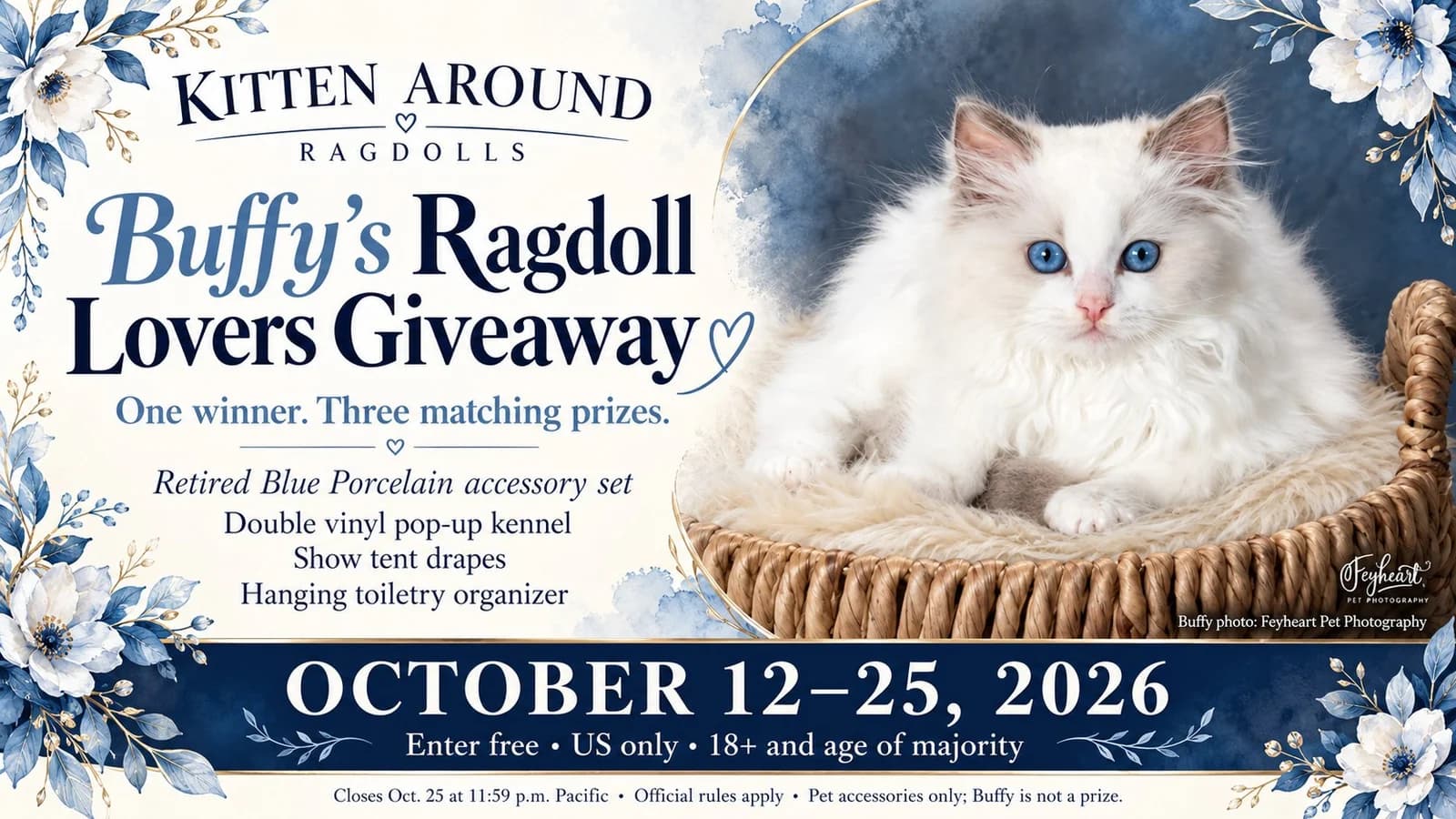
Buffy’s Ragdoll Lovers Giveaway: Win the Matching Blue Porcelain Set
10/10/2026
Do Ragdoll Cats Shed? A Grooming Routine That Fits Real Life
10/07/2026
BEP Ragdolls vs. Cherubim: What the Names Mean Before You Buy
09/26/2026
Who You Buy From Matters More Than You Think
Subscribe to our newsletter
Litter announcements, new posts, and the occasional discount — no spam.