Who You Buy From Matters More Than You Think
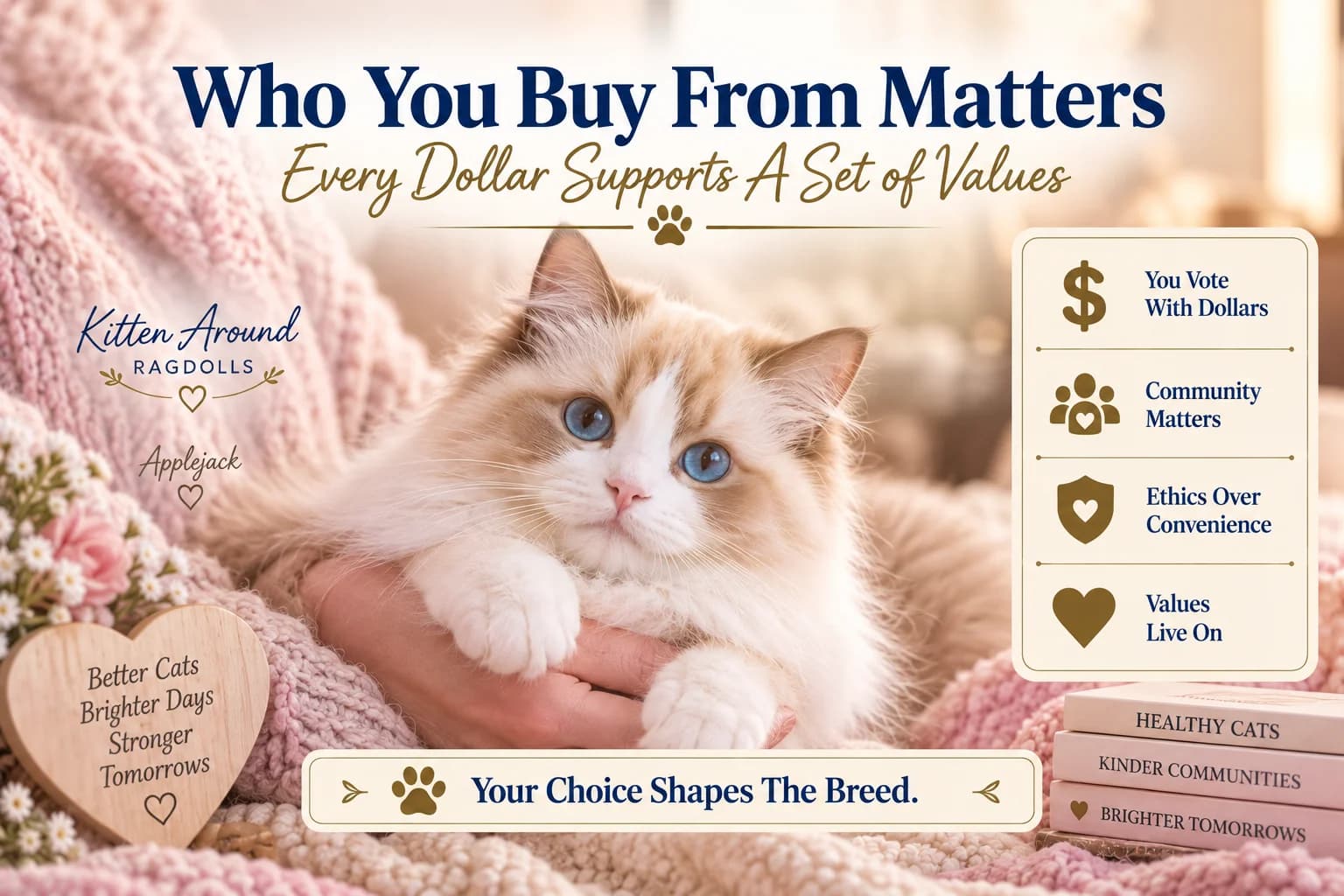
Who You Buy From Matters More Than You Think
My circle in the cat fancy is small. It’s small on purpose.
The breeders I work closely with — the ones I mentor with, learn from, refer buyers to, and would trust with any decision about my own cats — share not just my ethics and passion for the breed, but something more important: they’re genuinely good human beings who treat other people well.
That last part matters more than most buyers realize. And here’s why it should matter to you too.
Every Ragdoll Purchase Is a Vote
When you spend $4,500 on a kitten, you’re not just paying for a cat. You’re making a statement — a statement about which kind of breeder you’re willing to fund with your money.
You’re voting for:
- The way that breeder treats their animals
- The health testing standards they choose to invest in (or skip)
- The way they treat other breeders in the community
- The way they treat their buyers before, during, and after the sale
- The values they’ll pass along to the next generation of breeders they either mentor or refuse to mentor
Every dollar you spend on a Ragdoll kitten either strengthens ethical breeding or weakens it. There’s no neutral option.
The Uncomfortable Truth About TICA Awards
Here’s something the fancy doesn’t like to say out loud: winning awards at cat shows doesn’t make someone a good breeder.
Some breeders win consistently at TICA shows because their cats have gorgeous conformation. That’s real. Beautiful cats win awards. But show wins don’t measure:
- Whether the breeder is producing cats with sound temperaments
- Whether their genetic health protocols are current
- Whether they treat their kittens’ new families with respect
- Whether they treat other breeders in the community with basic human decency
- Whether they’re producing the traditional docile Ragdoll temperament or just cats that look pretty on a show table
Some award-winning breeders are truly wonderful. Some are not. The wall of ribbons tells you what the cats look like. It tells you very little about who the human is behind them.
If a breeder’s marketing leans heavily on show wins, look past that. Ask about the cats themselves. Ask about their buyers. Ask what they’re doing to make the breed better in the next generation. Awards are one data point. They aren’t the whole picture.
What “Supporting a Breeder” Actually Means
When you buy from a breeder, here’s what you’re actually supporting:
You’re supporting their environment. Every cent of profit either goes into better care, better testing, better facilities, better mentorship, and better outcomes — or it doesn’t. If a breeder cuts corners on everything, your money isn’t going into cat welfare. It’s going into their pocket.
You’re supporting their reputation in the community. When you buy from someone with a bad reputation, you’re telling them: “This is fine. Keep doing what you’re doing.” When you buy from an ethical breeder, you’re strengthening their ability to continue doing this work well.
You’re supporting their treatment of other people. If a breeder is nasty to colleagues, dismissive to newer breeders trying to learn, gossipy or cliquish or exclusionary — buying from them tells them it doesn’t matter. Their behavior is validated. They can keep being that person.
You’re supporting the future of the breed. The breeders you fund today are the breeders who shape what Ragdolls look like tomorrow. Your dollars have generational impact whether you realize it or not.
What to Actually Look For
If you want to fund good work with your Ragdoll purchase, look for these signs in a breeder:
- They speak respectfully about other breeders — even ones they disagree with. Someone who runs down every colleague is a red flag, not evidence they’re better than everyone else.
- They have mentors and they mention them — usually with genuine appreciation. Breeders who came up with no help and no relationships often have their own reasons for not building community.
- They mentor others — or at least engage kindly with newer breeders coming into the community. Legacy-minded breeders think about who comes next.
- They’re not defensive when asked hard questions — about health testing, contracts, past buyers, or their practices. Defensiveness signals hiding.
- They don’t badmouth past buyers — even ones who returned kittens. If a breeder tells you horror stories about the “difficult buyers” who dared to have concerns, imagine how they’ll talk about you.
- They’re generous with information — with buyers, with vets, with other breeders. Real experts share knowledge. Insecure people hoard it.
- Their long-term buyers speak well of them — the true test of a breeder isn’t the excitement of the initial sale but the relationship five and ten years later.
Questions to Ask Yourself Before You Buy
Beyond evaluating the breeder, ask yourself some honest questions:
- Am I choosing this breeder because their values match mine, or just because they had a kitten available first?
- Am I ignoring red flags because I want to fast-track my adoption?
- If I found out publicly, three years from now, that this breeder had done something unethical, would I be embarrassed to have bought from them?
- Am I making this decision based on what I’ve verified, or based on how the marketing made me feel?
- Would I be proud to tell people who I bought my cat from?
These questions aren’t easy. Most buyers don’t ask them at all. But they matter — because the answers determine what kind of breeding community we all end up with.
Why My Circle Is So Small
I don’t work with everyone. I don’t refer to everyone. I don’t recommend every breeder who asks for a mention. And I never will.
The breeders I trust — the ones I actually send buyers to when I don’t have kittens available — are the ones I’ve watched over time. Watched how they treat their cats. Watched how they treat their buyers. Watched how they treat other breeders when they think no one important is looking. Watched how they respond when things go wrong, because things always eventually go wrong in this work.
Some of them are people who mentored me. Some are people I met at shows and stayed in touch with because their character was as good as their cats. All of them share a foundation: they’re ethical breeders AND they’re kind humans. Both. Neither is optional.
My small circle is a feature, not a limitation.
What This Means for You
When you’re evaluating a Ragdoll breeder, look at the whole picture. The cats. The testing. The contracts. The website (or lack of one, per our last post). And also — how they treat people. How they talk about their peers. Who mentions them respectfully, and who talks around them politely.
You’re not just buying a cat. You’re joining a community, whether you know it or not. Make sure it’s a community you’re proud to be part of.
A Final Note
None of this means you have to only buy from me. There are truly wonderful Ragdoll breeders throughout North America and beyond, many of whom I know and would happily recommend if we don’t have the right kitten available for you.
What it means is that you should choose your breeder deliberately, not just conveniently. Your kitten is going to be part of your family for a decade or more. The breeder you buy from — their values, their ethics, their treatment of other humans — is part of the story you’ll tell about your cat forever.
Choose someone whose values you’d be proud to fund.
Questions?
If you’re evaluating a breeder and want to talk it through — even a breeder that isn’t us — reach out. This work only gets better when buyers hold breeders to a real standard.
Related Reading
- An Old Website Doesn’t Mean a Bad Breeder
- Why Cheap Ragdoll Kittens Are Actually Expensive
- Our Complete Ragdoll Buyer’s Guide
🐾 Meet Us. Ask The Hard Questions.
If our values align with yours, we’d love to talk about what a Kitten Around Ragdolls kitten could look like in your home.
Looking for a Ragdoll kitten from a breeder whose values you’d be proud to support? Check our available kittens or join our waitlist for upcoming litters. We’re a TICA-registered cattery in Sacramento, CA, breeding for health, temperament, and the traditional Ragdoll standard.
Recent Blogs
09/23/2026
What Ragdoll Health Testing Actually Includes: A Complete Guide
09/21/2026
Why Cheap Ragdoll Kittens Are Actually Expensive: A Breeder’s Warning
09/12/2026
What’s Included When You Buy a Ragdoll Kitten From Us

09/09/2026
What Our Past Buyers Just Told Us About Their Cats — And What We Changed Because of It
09/05/2026
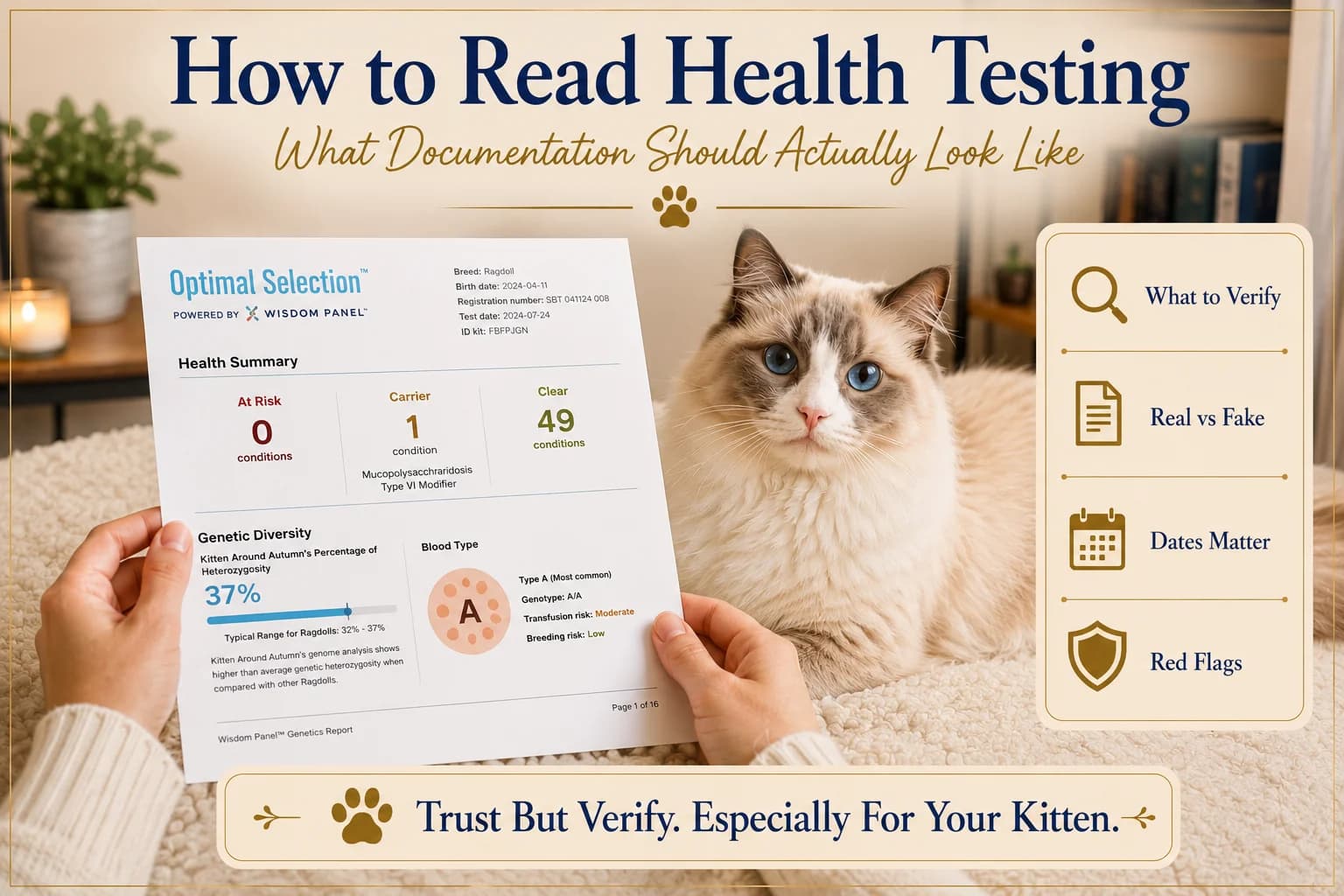
How to Read a Ragdoll Breeder’s Health Testing (What Documentation Should Actually Look Like)
Subscribe to our newsletter
Litter announcements, new posts, and the occasional discount — no spam.