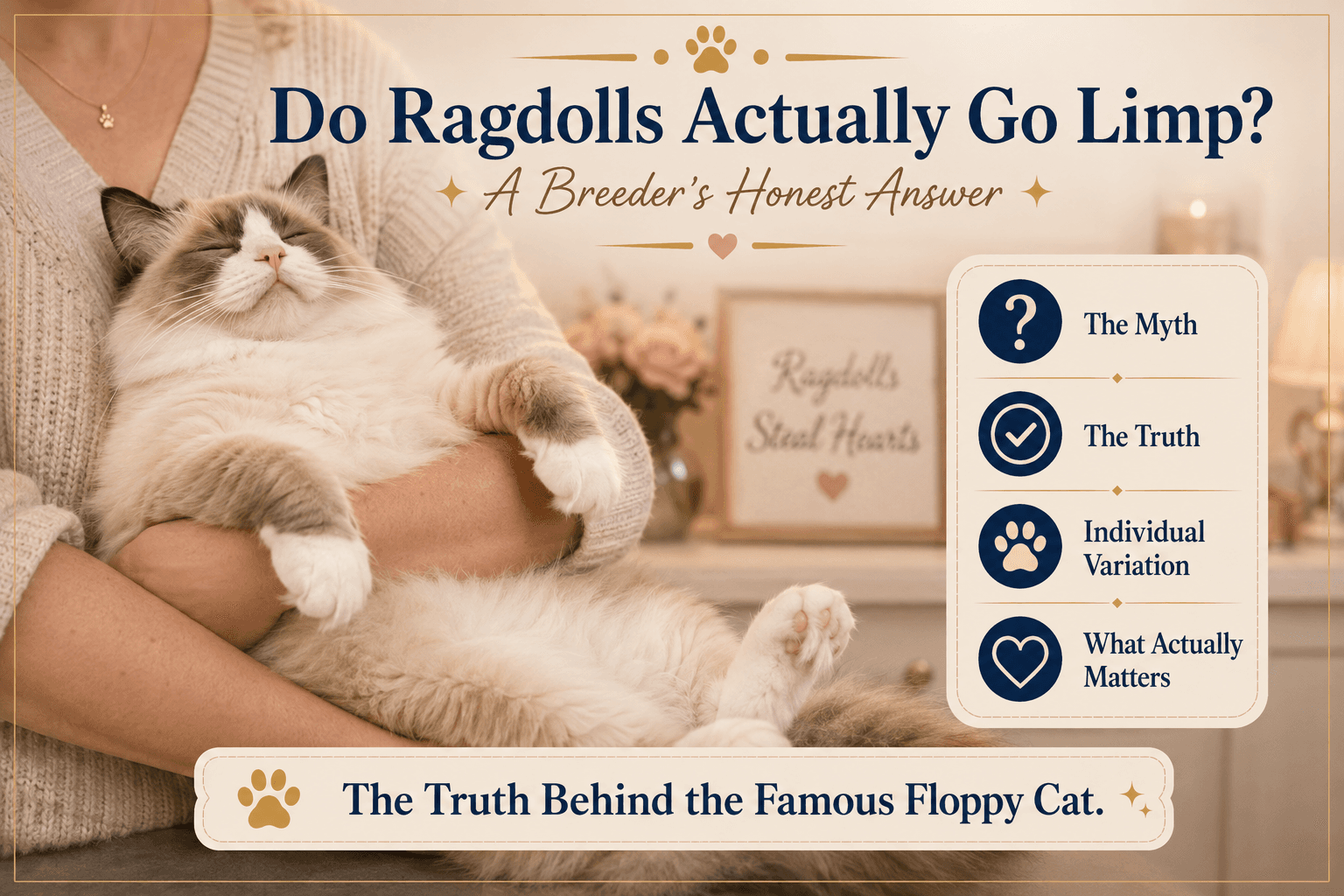
Do Ragdolls Actually Go Limp When You Hold Them? A Breeder’s Honest Answer
If you’ve spent any time researching the Ragdoll breed, you’ve heard it: “They go limp like a ragdoll when you pick them up!” It’s in every breed description. It’s the whole reason for the name. It’s the thing that makes Ragdolls sound like magical stuffed animals in cat form.
But is it actually true?
The short answer: yes, but with a lot of nuance. The longer answer is more interesting — and much more useful if you’re trying to decide whether to bring one of these cats home.
Let me walk you through what the “flop” actually is, where the myth came from, what it looks like in real life, and what actually makes Ragdolls special (spoiler: it’s not just the flop).
Where the “Ragdoll” Name Came From
The breed was developed in the 1960s in California by a woman named Ann Baker. She bred a white long-haired cat named Josephine to several other cats, and the offspring had a distinctive characteristic: they became remarkably relaxed and floppy when picked up.
Ann Baker named the breed “Ragdoll” specifically because of this trait. The idea was that the cats went limp like a ragdoll toy when you held them — a novel and marketable trait that helped establish the breed as unique.
Ann Baker also made some far-fetched claims about the origin of the trait (that it was the result of genetic mutation, that it came from cats crossed with skunks, that it made them impervious to pain). Most of those claims have been disproven. But the core observation — that these cats are unusually calm and relaxed when handled — is genuinely true.
What “Going Limp” Actually Looks Like
Here’s the honest picture of what you’ll actually experience with a Ragdoll:
Pick up a well-socialized Ragdoll, and their body relaxes in a way most cats do not. Their front legs often hang. Their back legs relax. Their head may tilt back. They don’t tense up. They don’t hold themselves rigid. They don’t struggle.
Is it “going limp” like a rag doll? Not quite. Their muscles still have tone. They’re not unconscious or paralyzed. It’s more accurate to say they fully surrender to being held — they trust you completely, they don’t feel the need to escape, and their body reflects that trust by relaxing.
Some Ragdolls will:
- Drape over your shoulder like a scarf
- Lay on their back in your arms like a baby
- Let you cradle them upside down without struggling
- Fall asleep in weird positions while being held
- Let you gently move their legs and paws without tensing
That’s the Ragdoll flop. It’s real. It’s remarkable. And once you experience it with your own cat, you understand why the breed name stuck.
But Here’s the Nuance…
Not every Ragdoll flops the same way. In fact, individual variation within the breed is huge. Some Ragdolls are extremely floppy. Some are only moderately floppy. Some barely flop at all.
What determines how “floppy” an individual Ragdoll will be?
1. Their Individual Personality
Ragdolls are bred for calm temperament, but individual cats still vary. Some are extremely laid-back extroverts (like our own Twilight Sparkle, who’s floppy to an extreme degree). Some are more energetic and less patient with being held. Some are affectionate but prefer to sit on you rather than be picked up.
Personality is genetic, but not perfectly predictable. Two littermates can have very different levels of floppiness.
2. Their Socialization
A Ragdoll who’s been gently and frequently held from kittenhood becomes an incredibly floppy adult. A Ragdoll who wasn’t handled much as a kitten may retain some Ragdoll traits but never fully develop the classic flop.
This is one reason we spend so much time handling and holding our kittens at Kitten Around Ragdolls. The floppy trait is genetic potential, but it’s activated and reinforced through positive human contact.
3. Their Age
Kittens are typically less floppy than mature adult Ragdolls. They wiggle. They wriggle. They want to explore. Full flop-mode usually develops as the cat matures — often around 1-2 years old and continuing to develop through age 4 (when Ragdolls are fully mature).
If you bring home a 12-week-old kitten and they don’t immediately melt in your arms, don’t worry. They will.
4. Their Comfort in the Moment
Even the floppiest Ragdoll won’t be floppy if they’re stressed, frightened, or in an unfamiliar environment. The flop is a trust behavior. It requires:
- A calm, familiar environment
- A person they know and trust
- Gentle, non-restraining handling
- Their own willingness in that specific moment
Pick up a Ragdoll at the vet? Probably not floppy. Pick up a Ragdoll on your couch after breakfast? Probably very floppy.
What Actually Makes Ragdolls Special (Beyond the Flop)
Here’s what I wish more Ragdoll marketing focused on: the flop is just one visible expression of a much bigger truth about the breed. Ragdolls are unique because they were selectively bred to be the most human-oriented, docile domestic cats possible.
What this actually looks like in daily life:
They Follow You From Room to Room
Ragdolls want to be with you. If you move to the kitchen, they follow. If you go to the bathroom, they may camp outside the door. If you sit on the couch, they sit with you. This “dog-like” trait is much more consistent across the breed than the flop.
They Tolerate Almost Anything
Ragdolls handle being picked up by children, having their paws touched, being groomed, being held in weird positions, and even having their nails trimmed with a calm that would be shocking in most cats. They’re not fussy or reactive. They roll with things.
They’re Not Aggressive
Ragdolls almost never bite or scratch defensively. Even when startled or annoyed, they typically walk away rather than attack. This makes them exceptionally safe cats for households with children, elderly family members, or people who haven’t had cats before.
They Bond Deeply
Ragdolls form deep, lifelong bonds with their people. They notice when you’re sad. They celebrate when you come home. They stay by your side when you’re sick. The bond is emotional, not just physical.
They Vocalize Softly
Ragdolls tend to have quiet voices — soft chirps and trills rather than loud demanding meows. They communicate, but not disruptively. Great for apartment living or households with sound sensitivity.
They Play Gently
Even when playing, Ragdolls tend to keep their claws sheathed and their bites soft. They’re careful with people. This is temperament breeding at its finest.
So Why Do People Sometimes Say Their Ragdoll Isn’t Floppy?
You’ll occasionally see Ragdoll owners online say their cat “doesn’t flop.” A few things can be going on:
They Might Have a Ragdoll Mix, Not a Pure Ragdoll
Backyard breeders and mills sometimes sell “Ragdoll” kittens that are actually mixes. These cats may look like Ragdolls but not carry the full temperament genetics. This is one of the biggest reasons to buy from a TICA-registered ethical breeder — you’re actually getting the breed, not a look-alike.
Their Cat Might Have a Less-Floppy Individual Personality
Even purebred Ragdolls have individual variation. Some cats are less floppy but still incredibly bonded, gentle, and loving. Not every Ragdoll wins the “extreme flop” contest.
They Might Not Have Socialized Their Kitten Extensively
The flop is genetic potential, but early handling reinforces it. Kittens who were left alone too much in their early weeks may never fully develop the trait.
Their Cat Might Just Be Having a Moment
Even the floppiest Ragdoll isn’t floppy 100% of the time. They have moods and preferences like any cat.
Should You Buy a Ragdoll Just for the Flop?
Honestly? No. Buy a Ragdoll for the whole package — the affectionate temperament, the intelligence, the beauty, the bond. If you get the flop too (and you almost certainly will), it’s a wonderful bonus.
If flop is your only criteria, you might be disappointed if you get a less-floppy individual cat. And you’d be missing what actually makes the breed special — a companion animal who is genuinely bred to love being with humans.
How to Tell If a Kitten Will Be Floppy as an Adult
If you’re evaluating a kitten in person or through videos, look for:
- Calm when handled: Do they relax when picked up, or immediately squirm?
- Interest in faces: Kittens who study your face and hold eye contact tend to grow into the most bonded adults
- Willingness to be cradled: Watch them let you gently move their limbs
- Comfort with belly exposure: Kittens who let you rub their bellies without protest are showing early trust behavior
- Snuggling siblings: Watch how they interact with their littermates. Kittens who cuddle up to their siblings tend to be the cuddliest with humans too
We watch for all of these signs in every kitten we raise, and we match kittens to buyers based on temperament. If you specifically want an extreme flopper, tell us — we’ll steer you toward the kittens showing that potential from an early age.
The Real Answer
Yes, Ragdolls really do go limp when held. It’s not marketing hype — it’s a real trait of the breed. But it varies from cat to cat, it develops over time, and it’s just one part of what makes the breed extraordinary.
The flop is the visible surface of something much bigger: a cat who was bred over generations to trust you completely. Once you understand that, everything else about the breed makes sense.
Come Experience It for Yourself
Nothing describes the Ragdoll flop like actually experiencing it. If you’d like to meet our cats or discuss whether a Ragdoll is right for your household, please reach out.
🐾 Ready to Meet a Real Ragdoll?
The flop has to be felt to be believed. See our available kittens or join our waitlist for upcoming litters.
Looking to bring home a real Ragdoll from a real TICA-registered breeder? Check our available kittens or join our waitlist for upcoming litters. We’re a TICA-registered cattery in Sacramento, CA, breeding for health, temperament, and the traditional Ragdoll standard — including the famous floppy trait.
Recent Blogs
08/14/2026
How I Became a Breeder — And What I Wish More Breeders Were Doing
08/13/2026
How Does a Ragdoll Breeder Waitlist Actually Work?
08/08/2026
Comprehensive Health Testing on Every Ragdoll Kitten: Our New Standard
08/05/2026
How We Ensure Every Ragdoll Kitten Is Healthy: Our Complete Cattery Protocol Focus
07/29/2026
How to Buy a Ragdoll Kitten: A Breeder’s Complete Guide to Getting It Right
Subscribe to our newsletter
Litter announcements, new posts, and the occasional discount — no spam.