HCM Testing in Ragdolls: The DNA Test, the Echo, and What Everyone Gets Wrong
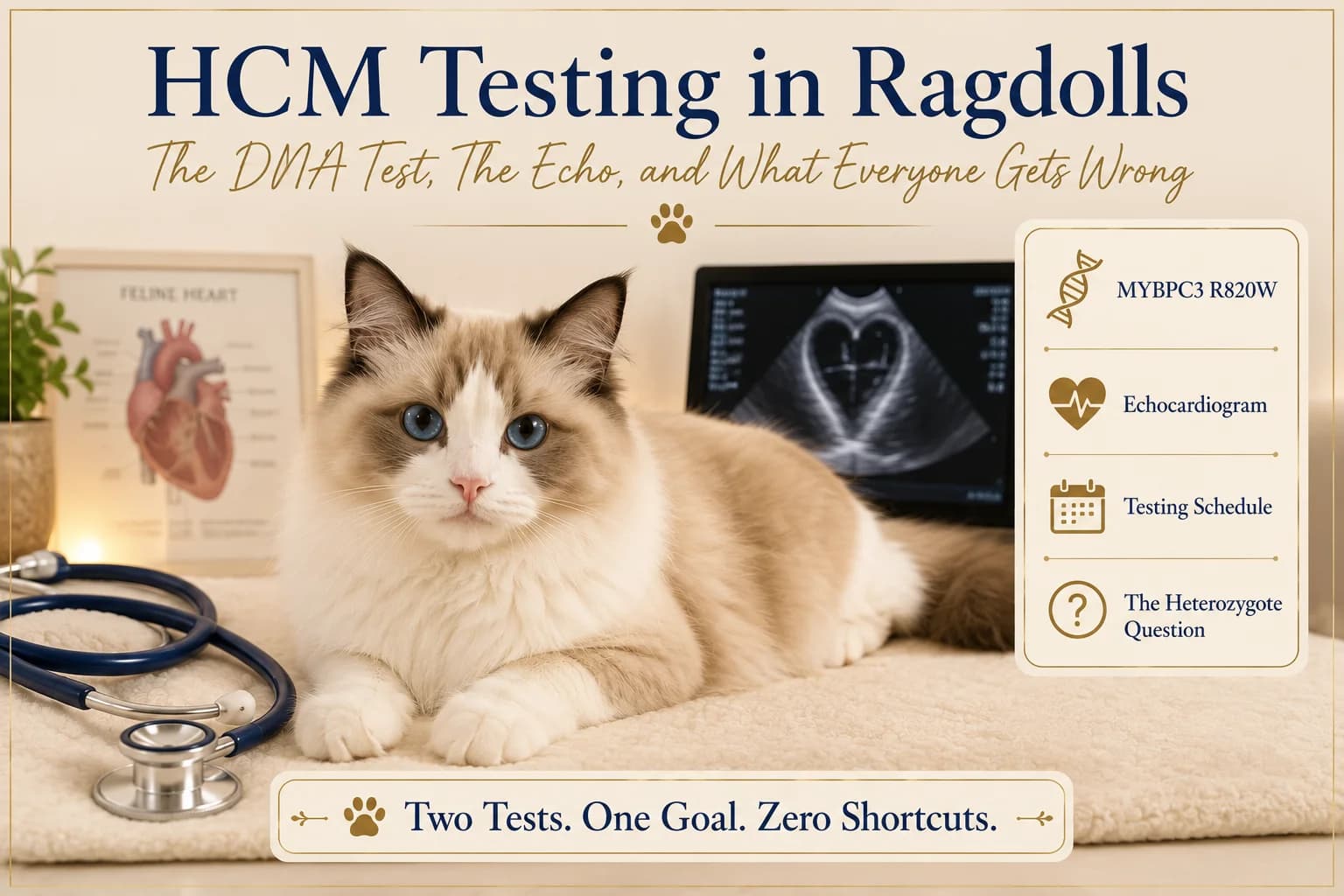
HCM Testing in Ragdolls: The DNA Test, the Echo, and What Everyone Gets Wrong
This post is for breeders, prospective breeders, technical readers, and anyone who wants to genuinely understand HCM testing in Ragdolls beyond the marketing language.
Hypertrophic cardiomyopathy (HCM) is the most common heart disease in cats and the single most important condition to screen for in Ragdolls. Testing is not one thing — it’s two coordinated things done together. This is a walk-through of what each is, what each does, what the results actually mean, and where the sources genuinely disagree.
The Two-Test Baseline
The current standard of care for Ragdoll HCM screening has two components:
- The MYBPC3 R820W DNA test — a one-time genetic test that identifies whether a cat carries a specific mutation linked to HCM in Ragdolls
- Periodic echocardiography by a board-certified cardiologist — ongoing diagnostic imaging to identify structural changes in the heart over time
Both are needed. Neither replaces the other. A negative DNA test does not guarantee an HCM-free cat, and a clean echo doesn’t tell you what the cat might pass to offspring.
The MYBPC3 R820W DNA Test
The reference lab in the United States is UC Davis Veterinary Genetics Laboratory (VGL). Their test description is precise: R820W is “a single base pair change in MYBPC3.” The test currently runs about $47 and takes approximately 15 business days.
Results come back as one of three genotypes:
N/N (Negative/Normal Homozygote)
Two normal copies of the gene. The cat does not carry the R820W mutation. This is the desired genotype.
N/HCM (Heterozygote)
One normal copy and one mutation copy. This is where the sources start to diverge — see the next section.
HCM/HCM (Homozygous Positive)
Two copies of the mutation. UC Davis states these cats “are at high risk of developing severe HCM signs, usually between 1-2 years of age.”
PawPeds and other health organizations are clear: homozygous cats should not be used in breeding programs.
The Heterozygote Question (Where Sources Genuinely Disagree)
This is the most important nuance in Ragdoll HCM discussion, and it’s the area where responsible breeders have to actually make judgment calls.
UC Davis Position
UC Davis describes heterozygous cats as “not likely to show signs.” Their framing treats R820W heterozygotes as largely unaffected.
NC State Position
North Carolina State University’s cardiology service takes a notably different position: “heterozygous cats are more likely to develop a mild form of disease than positive homozygous cats.” They stress that “HCM is a disease of incomplete penetrance.”
Their recommendation includes annual echocardiography for any DNA-positive cat, regardless of homozygous or heterozygous status.
PawPeds Position
PawPeds takes a middle ground. They agree with UC Davis that heterozygous cats can be bred, but with an important caveat: heterozygous cats should only be bred to negative partners, and “it is not recommended to use homozygous cats.”
The Practical Read
Here’s how we reconcile this in our program:
Heterozygote status is manageable but never a clean bill of health. A heterozygous cat can be an appropriate breeding cat if:
- Paired only with genetically-negative partners (never with another positive cat)
- Scanned by a cardiologist annually per the PawPeds schedule
- Immediately retired from breeding at any sign of structural cardiac changes
- Buyers are told the parent is heterozygous — this is not something to hide
The disagreement between UC Davis and NC State isn’t a case of one being right and one being wrong. Both are credible institutions interpreting the same underlying research differently. HCM is a disease of incomplete penetrance — meaning genotype doesn’t perfectly predict phenotype in individual cats. That’s why the ongoing echocardiography matters even more when heterozygous cats are in the program.
The Echocardiography Schedule
PawPeds maintains the widely-used echocardiography schedule for breeding cats:
- First scan at age 1 before any breeding use
- Annual scans until age 3
- Follow-up scan at age 5
NC State recommends annual echocardiography for any DNA-positive cat regardless of the standard schedule.
Any cat diagnosed with HCM at any degree should not be used in breeding — full stop. This applies whether the diagnosis comes from an early scan or emerges years into a breeding career.
Why the Echo Cannot Be Skipped
The MYBPC3 R820W DNA test identifies one specific mutation associated with HCM in Ragdolls. It’s not the only mutation that causes HCM. Cats can develop HCM without carrying R820W — either through other identified mutations, unidentified mutations, or non-genetic factors.
A comprehensive HCM screening program cannot rely on DNA testing alone. Echocardiography catches the disease when it manifests, regardless of underlying genetic cause.
What Not to Rely On
Several screening approaches get confused for actual HCM screening but shouldn’t be trusted as substitutes.
NT-proBNP Alone
The American College of Veterinary Internal Medicine (ACVIM) is unambiguous: the quantitative NT-proBNP assay “is not recommended for differentiating normal cats from cats with mild to moderate HCM.” NT-proBNP has some utility in specific clinical contexts but cannot replace echocardiography for screening.
Auscultation Alone
Many affected cats have no detectable murmur. A vet listening to the heart and saying “sounds fine” tells you very little about whether HCM is present. Auscultation is not a substitute for imaging.
General Practitioner Ultrasound
Cardiac imaging for HCM screening should be performed by a board-certified veterinary cardiologist. General practitioner ultrasound has value in emergency assessment but is not the standard for HCM screening in breeding cats. Board certification exists specifically because subtle cardiac changes require trained interpretation.
PKD Testing: Lower Priority Than Folklore Suggests
Polycystic kidney disease was historically treated as a critical Ragdoll screening priority. The current data suggests it deserves less focus than the folklore around it implies.
A retrospective Ragdoll screening study found PKD prevalence less than 3% in Ragdolls, compared to 31-42% in Persians. The study found only two positives in its final seven years, indicating that pre-breeding PKD1 testing has already effectively removed the mutation from most responsible breeding programs (source).
Practical implications:
- Test every breeding cat for PKD1 once — genotype doesn’t change, so annual retesting wastes money
- Positive results should not enter breeding programs
- PKD1 testing remains standard even though prevalence is low, because verification is the reason prevalence stays low
Interestingly, the same study found 8.6% of Ragdolls had ultrasound changes compatible with chronic kidney disease unrelated to PKD. This is useful context — CKD is a broader kidney health topic that matters even when PKD isn’t the cause.
The Full Testing Panel
Beyond HCM and PKD, current best practice for Ragdoll breeding cats includes:
- UC Davis VGL Ragdoll panel — PKD1, PRA (rdAc), MPS VI, parentage verification, coat color tests (panel details). UC Davis is the US reference standard for genetic testing.
- Wisdom Panel Optimal Selection Feline — the mainstream breeder-focused panel. Screens 50+ genetic conditions plus blood type, genetic diversity, and coat traits. Note: the old
breeder.wisdompanel.comportal was retired in 2023; archived reports are now request-only (notice). - Blood typing — UC Davis specifically notes “the variant resulting in AB blood type, reported as c, identified in Ragdolls.” Blood typing lets breeders “use this test for mate selection to avoid NI in kittens” (source). Neonatal isoerythrolysis is preventable through pre-breeding typing and is a real risk in Ragdoll populations.
Documentation Standards a Buyer Should Expect in 2026
The current standard for buyer-facing documentation:
- Dated PDF certificates naming the lab and the cat’s registered name — not a screenshot showing “N/N”
- A cardiologist’s echo report with date and credentials for both parent cats — not a general practitioner assessment
- Honest framing that an echo is point-in-time — a clean scan at age 1 is not a guarantee at age 5
- Publishing actual PDFs, rather than claiming “fully health tested,” is the differentiator
For a full breakdown of what documentation should look like, see our post on how to read a Ragdoll breeder’s health testing.
📄 See a Real HCM Testing Report
Want to see a real UC Davis DNA test certificate and cardiologist echo report from one of our breeding cats? Sign up below and we’ll send you sample documents (marked as sample, for reference only).
What We Do at Kitten Around Ragdolls
Our HCM protocol:
- UC Davis MYBPC3 R820W DNA test on every breeding cat
- Full UC Davis Ragdoll genetic panel on every breeding cat
- Wisdom Panel Optimal Selection Feline as our secondary comprehensive panel
- Blood typing on every breeding cat (Type A, B, or AB documented)
- Board-certified cardiologist echocardiogram at age 1 before breeding
- Annual echocardiography per PawPeds schedule until age 3, then age 5 follow-up
- Additional annual echoes for any DNA-positive cat per NC State recommendation
- Immediate breeding retirement on any diagnosed cardiac changes
- All results shared as PDF documents on request
Our full health protocol is documented in our post on how we ensure every Ragdoll kitten is healthy.
Questions From Other Breeders
If you’re a Ragdoll breeder implementing or refining your own HCM protocol and want to discuss any of this — sources, interpretation, cardiologist referrals in Northern California, or how we handle heterozygote cases — please reach out. Breed health is a shared responsibility and I’m always happy to talk shop with colleagues.
Sources Referenced
- UC Davis Veterinary Genetics Laboratory: Ragdoll HCM Test
- UC Davis VGL: Ragdoll Testing Panel
- UC Davis VGL: Cat Blood Group Test
- NC State CVM: Ragdoll HCM
- PawPeds HCM Recommendations
- EveryCat: Ragdoll Cats and Kidney Disease
- Wisdom Panel Optimal Selection: Deprecated Breeder Site Notice
Related Reading
- What Ragdoll Health Testing Actually Includes: A Complete Guide
- How to Read a Ragdoll Breeder’s Health Testing
- How We Ensure Every Ragdoll Kitten Is Healthy
🐾 Kittens From Fully-Tested Parents
Every breeding cat in our program follows the protocol above. See our available kittens or join our waitlist for upcoming litters.
Looking for a Ragdoll kitten from a breeder committed to rigorous HCM screening and full documentation? Check our available kittens or join our waitlist for upcoming litters. We’re a TICA-registered cattery in Sacramento, CA, breeding for health, temperament, and the traditional Ragdoll standard.
Recent Blogs
10/07/2026
BEP Ragdolls vs. Cherubim: What the Names Mean Before You Buy
09/26/2026
Who You Buy From Matters More Than You Think
09/23/2026
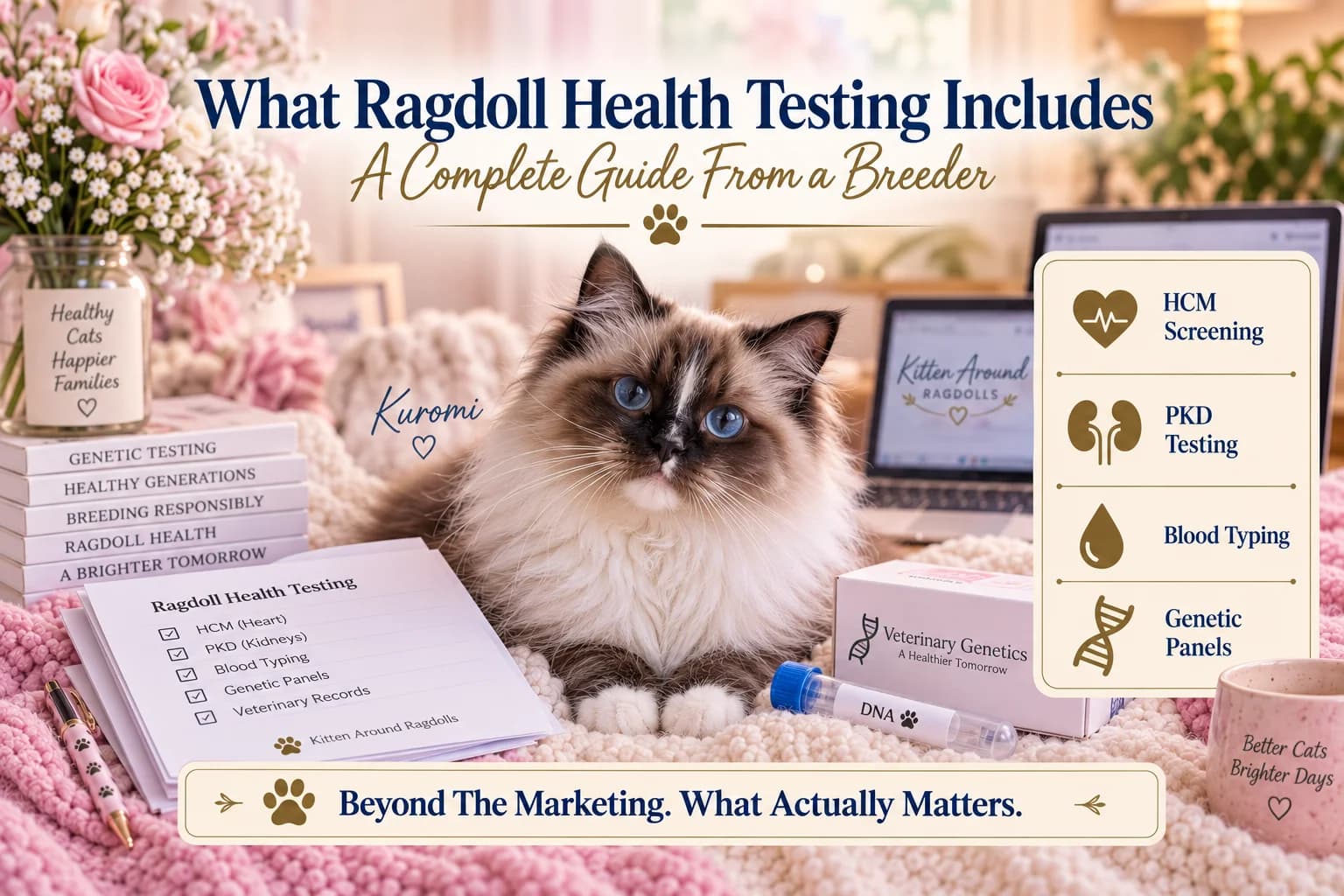
What Ragdoll Health Testing Actually Includes: A Complete Guide
09/21/2026
Why Cheap Ragdoll Kittens Are Actually Expensive: A Breeder’s Warning
09/12/2026
What’s Included When You Buy a Ragdoll Kitten From Us

09/09/2026
What Our Past Buyers Just Told Us About Their Cats — And What We Changed Because of It
Subscribe to our newsletter
Litter announcements, new posts, and the occasional discount — no spam.