Why We Use Amazon Dog Crates as Birthing Nests for Our Mama Cats
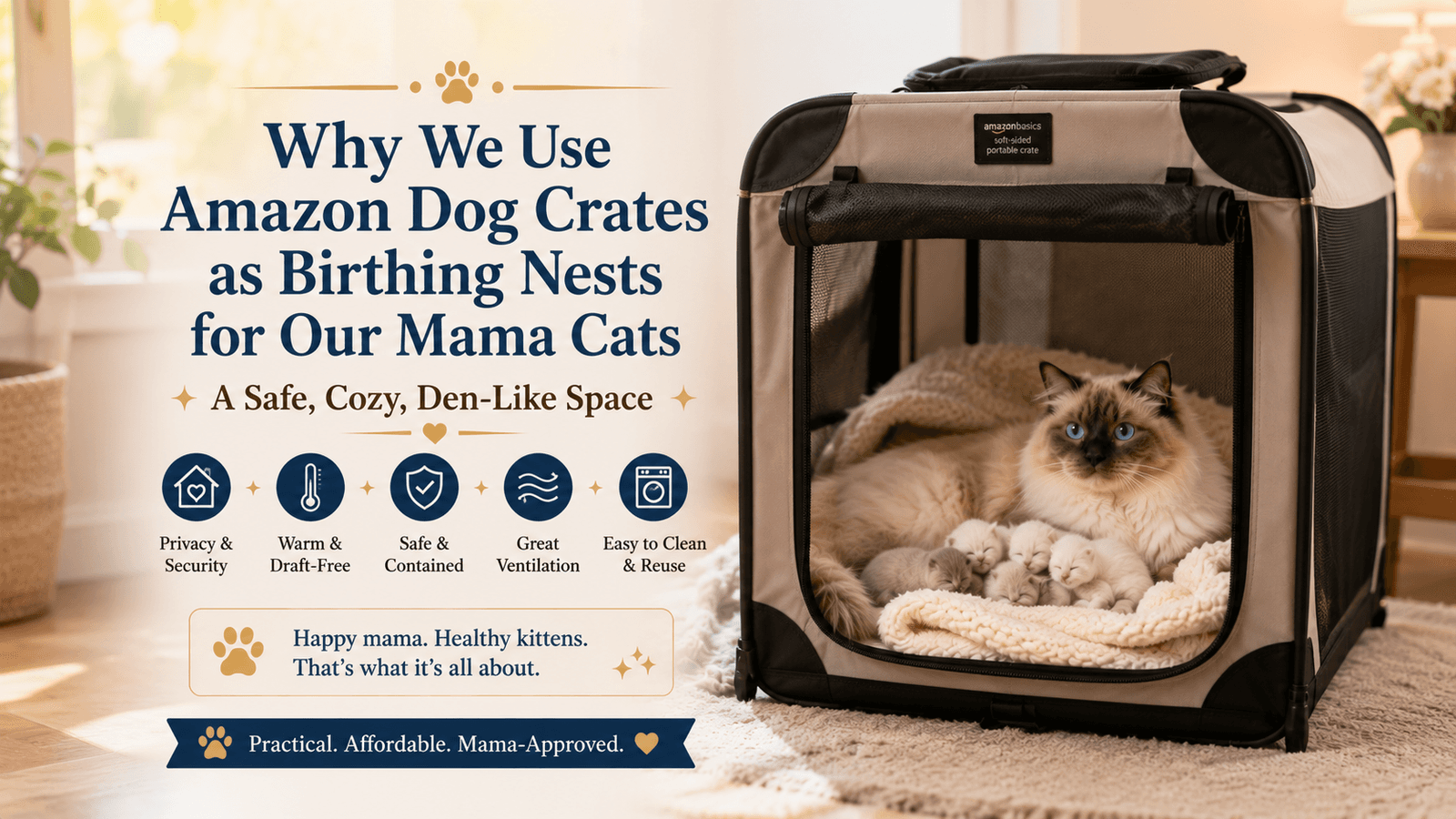
When we started Kitten Around Ragdolls, one of the first things we had to figure out was where our mama cats should give birth. Like a lot of new breeders, we tried the traditional approach first — open-top cardboard whelping boxes, custom-built wooden queening boxes, even repurposed plastic storage bins lined with soft bedding. Every setup we tried had a problem: too open, too exposed, hard to clean, or simply not the kind of safe, den-like space a mama cat actually wants when she’s about to deliver her kittens.
Then we tried something a little unexpected: soft-sided Amazon dog crates. And it changed everything.
If you’re a breeder looking to build a birthing setup that genuinely supports your mamas (and is easy on you), this is the system we use across our cattery, and the reasoning behind it. We’re sharing it because we wish someone had told us sooner.
What a Mama Cat Actually Needs When She Gives Birth
Before we talk about the crate itself, it helps to understand what a queen is instinctively looking for in the days leading up to labor. Cats are den animals. In the wild, a mama cat would tuck herself into a small, dark, enclosed space — under a porch, inside a hollow log, in the back of a closet — anywhere she feels protected from predators and other animals. The smaller and more enclosed the space, the safer she feels. The safer she feels, the calmer her labor goes, and the better the outcomes for her kittens.
The mistake a lot of new breeders make is providing a birthing space that feels comfortable to us — open, well-lit, easy to access — when what the mama actually wants is the opposite. She wants a den. A small, dark, enclosed cave that she has chosen for herself and feels in complete control of.
That’s where the soft-sided dog crate comes in.
Why Soft-Sided Dog Crates Work So Well as Cat Birthing Nests
We use a small-to-medium soft-sided dog crate for each of our mamas. After years of using them across many litters, here’s why they consistently outperform every other birthing setup we’ve tried.
1. The size is exactly right
This is the most underrated thing about these crates. They’re big enough that a mama cat can stretch out, snuggle with her babies, nurse comfortably, and turn around freely. But they’re small enough that she still feels enclosed and held — like a den, not a room.
An oversized birthing box can actually stress a mama out. If she has too much space, she doesn’t feel as protected, and some mamas will even abandon a birthing area that feels too exposed. The soft-sided dog crate hits the sweet spot every time. Look for a crate roughly 24 to 30 inches long for most domestic cat breeds. For our Ragdolls, who can run on the larger side, we lean toward the medium size.
2. The interior is dark and secluded
Soft-sided crates have fabric walls and a roof, so the interior is naturally dim and cave-like. Even with the room lights on, the inside of the crate stays softly lit. For a queen in labor, this matters enormously. Darkness lowers stress hormones, helps her relax into her contractions, and reduces the chance she’ll try to relocate her kittens mid-labor (a stress response that’s stressful for everyone).
3. Mesh panels + zippers on every side
This is the feature that sold us. Every soft-sided dog crate we use has mesh windows on all sides, and zippered openings on multiple panels. This gives us two things at once:
- Breathability. Mesh keeps the interior well-ventilated, so the crate never gets stuffy or overheats — even with a mama and several nursing kittens inside.
- Easy access from any angle. When we need to check on a mama, weigh a kitten, swap out a soiled blanket, or quietly observe a delivery, we can unzip whichever panel makes the most sense in the moment without disturbing her from the front.
For a breeder, this is huge. Traditional wooden whelping boxes only open from the top, which means you’re looming over the mama every time you need to do anything. Soft-sided crates let you come in from the side or back, much less intrusively.
4. Each mama can have her own nest
We assign each of our queens her own dedicated crate well before her due date. We set it up in her usual space, fill it with familiar-smelling blankets, and let her start exploring and napping in it during the last week or two of pregnancy. By the time labor begins, she already knows exactly where her safe space is. The moment contractions start, she goes straight to it.
This is one of the most underrated benefits of the system: the mama makes the decision for you. You’re not running around at 2am trying to convince a laboring queen to use the birthing area you set up. She’s already there.
5. Cleanup and disinfection are simple
Cattery work is hard enough without fighting your equipment. Here’s what cleanup looks like with a soft-sided crate:
- Wipe down the interior with a safe cattery disinfectant after birth.
- Swap out the puppy pads we line the bottom with during labor and delivery.
- Switch the soft blankets for fresh ones daily during the early postpartum days.
- When the litter is weaned, unzip everything fully, take the whole crate apart, and wash the fabric panels.
Compare that to scrubbing a wooden whelping box that’s absorbed amniotic fluid, or trying to sanitize a plastic bin that’s already starting to retain odors. Soft-sided crates are dramatically easier to keep clean across multiple litters and over time.
How We Set Ours Up
Each crate gets the same setup, every time:
- Bottom layer: a thick puppy pad or two, which we change frequently during labor and the first week postpartum.
- Middle layer: a soft fleece blanket, washed and warm.
- A second small folded blanket the mama can push around and arrange to her liking — queens love to “build” their nest.
- The crate placed in a quiet room, away from foot traffic, drafts, and other cats.
We never put food or water bowls inside the crate during the first few days postpartum (those go just outside the entry, where mama can step out for a quick bite). We also keep the room temperature warm — 75-80°F is ideal for newborn kittens for the first two weeks.
Watching Our Litters Thrive in This Setup
We’re currently raising two litters across two of these crates, and watching the kittens grow up in them has been an absolute joy. Our mamas seem genuinely happy in their dens. Princess’s babies often pile into one crate while Dolly’s singleton, Jolene, hangs out in the other — and they all wander back and forth between the two nests once they’re mobile, with both mamas tolerating each other’s kittens beautifully.
The kittens themselves are thriving — eating solid food, using their tiny litter box, and very curious about the world. They play with their big sister Sakura and their newer baby sister Jolene, and they’re often piled together in one big kitten heap. The soft-sided crate is so welcoming that even our kittens choose to nap in it long after they’ve outgrown the need for one.
Where to Find the Crates
The exact crate we use is the Amazon Basics Portable Folding Soft Dog Crate (Medium, 29.92″ x 21.3″ x 21.3″, Tan). It’s double-door, collapsible, easy to assemble, and exactly the right size for most of our queens. You can also find it along with the rest of our cattery essentials in our Amazon storefront.
If you’re a new breeder setting up your first cattery, or an experienced breeder looking to streamline your birthing setup, give this one a try. Our mamas have voted with their paws, and the votes have been unanimous.
If you have questions about setting up a cattery birthing space, feel free to reach out — we love hearing from fellow breeders.
This post contains Amazon affiliate links. As an Amazon Associate, Kitten Around Ragdolls earns from qualifying purchases at no additional cost to you.
Related Reading
Recent Blogs

10/17/2026
Male vs. Female Ragdoll Cats: Choose the Individual, Not the Stereotype

10/14/2026
Can Ragdoll Cats Be Left Alone? Planning for Workdays and Real Life

10/12/2026
Buffy’s Ragdoll Lovers Giveaway: Win the Matching Blue Porcelain Set
10/10/2026
Do Ragdoll Cats Shed? A Grooming Routine That Fits Real Life
10/07/2026
BEP Ragdolls vs. Cherubim: What the Names Mean Before You Buy
09/26/2026
Who You Buy From Matters More Than You Think
Subscribe to our newsletter
Litter announcements, new posts, and the occasional discount — no spam.