Ragdoll Cat Colors and Patterns: Seal, Blue, Mitted and Bicolor

If you’ve spent any time researching Ragdoll cats, you already know they’re stunning. The names can be less straightforward. What is the difference between a seal bicolor and a seal mitted Ragdoll? Is blue a color or a pattern? Where does lynx fit?
The easiest way to understand a description is to separate color from pattern. Seal and blue describe color. Colorpoint, mitted, and bicolor describe the pattern of white markings, or their absence. Lynx describes tabby markings on the colored areas.
At Kitten Around Ragdolls, we breed blue-eyed pointed Ragdolls, often shortened to BEP. A lovely photograph can help you find a look you enjoy. We also want you to understand the individual cat you may be welcoming into your family.
Ragdoll Colors and Patterns at a Glance
| Part of the name | Examples | What it describes |
|---|---|---|
| Color | Seal, blue, chocolate, lilac, red, cream | The color of the pigmented areas |
| White-marking pattern | Colorpoint, mitted, bicolor | Where white markings occur |
| Tabby markings | Lynx | Stripes on the colored points |
| Mixed color description | Tortie; torbie when combined with tabby markings | A combination of red/cream and other coloring |
For example, blue lynx bicolor combines a color, tabby markings, and a white-marking pattern. You do not have to choose between “blue” and “bicolor.” They answer different questions.
What Does Pointed Mean?
The colored points are on the face, ears, legs, and tail, contrasting with a lighter body. UC Davis explains that this restriction involves temperature-sensitive pigment production: cooler extremities develop more pigment than warmer areas. White markings can cover parts of that underlying pointed pattern. Read UC Davis’s colorpoint explanation.
A bicolor with white feet and a white facial marking is still pointed. “Pointed” describes the broader color distribution; “colorpoint” is also commonly used for the pattern without white markings. That double use is one reason the terminology feels confusing.
Common Ragdoll Point Colors
Seal, blue, chocolate, lilac, red, and cream are familiar color names, but the list is not limited to six. TICA’s current Ragdoll overview also lists cinnamon and fawn. A color recognized in the breed does not mean our cattery produces it or currently has a kitten in that color.
Seal and Blue
Seal points look deep brown. Blue points look gray, rather than literally blue like a paint sample. UC Davis’s dilution genetics guide explains how dilution changes the appearance of pigment; blue is the dilute counterpart of seal.


Those two cats are both bicolors. Their color differs, while the white facial and body markings belong to the same general pattern description.
Chocolate and Lilac
Chocolate points have a warmer, lighter brown appearance than seal. Lilac is the dilute counterpart of chocolate and has a pale gray-pink appearance. Lighting and age can make colors difficult to distinguish in a photograph. The breeder’s records and, where relevant, genetic results provide context beyond a screen image.
UC Davis explains the brown variants associated with chocolate and cinnamon, separately from the dilution trait. These are different parts of the genetic picture.


Red and Cream
Red points are often described as flame; cream is the diluted appearance of red. These names describe coat color. They are not a reason to promise that a kitten will be more playful or affectionate.

Tortie and Torbie
Tortie describes a patchwork combination of red or cream with other coloring. Torbie adds tabby markings to that combination. These words add information to a description; they do not replace the white-marking pattern.


Colorpoint, Mitted, and Bicolor: Compare the Patterns
The current TICA Ragdoll Breed Group standard is the reference for show-pattern details. In plain language:
| Pattern | Main visual distinction |
|---|---|
| Colorpoint | Colored points without white markings |
| Mitted | White front mittens, hind boots, chin, and belly stripe; a facial blaze may occur |
| Bicolor | A white inverted V on the face, with white chest, underside, and legs |


Markings vary between individual cats. A show-standard detail does not measure how much love a companion deserves or establish its health. Ask the breeder to explain the kitten’s actual description rather than trying to grade it from one photograph.
Where Lynx Fits
Lynx is the familiar term for tabby markings on the points. A cat can be a lynx colorpoint, lynx mitted, or lynx bicolor. UC Davis’s coat-color reference explains that markings on the points depend on genes beyond the colorpoint trait itself.

Blue-Eyed Pointed Ragdolls and Cherubim
TICA’s current standard distinguishes blue-eyed pointed Ragdolls (RD) from Cherubim (CB), which have separate accepted color categories. Our program breeds BEP Ragdolls only. For the terminology and registration questions, read our BEP Ragdoll and Cherubim guide.
This is a distinction about accurate breed descriptions, not a judgment about another family’s cat. Blue eyes or a pointed coat alone cannot establish pedigree. Ask which registry issued the documents and how the description matches those records.
Choosing a Color Without Overlooking the Kitten
It is perfectly fine to love a particular look. We also want to talk about the companion who will share your daily life. What does the kitten enjoy? How do they respond to people? What kind of activity and handling are comfortable for them?
We watch our kittens as individuals and discuss household fit with each family. Color is one preference in that conversation, not a substitute for it. Our companion kitten price is $4,500 regardless of color or pattern; see our pricing guide and current terms for details.
Frequently Asked Questions
What is the difference between blue bicolor and blue mitted?
Both have blue coloring. Bicolor and mitted describe different white markings: compare the face, chin, legs, and underside in the pattern table above.
Are seal point and seal mitted the same?
They share seal coloring. In the usual pattern descriptions, seal colorpoint has no white markings, while seal mitted has the white mittens and other mitted markings.
Do Ragdoll kittens change color as they grow?
Yes. A young pointed kitten’s color is still developing. TICA allows for undeveloped kitten color and notes that full color may take until about three years. Compare photographs with age and lighting in mind, and avoid asking one baby photo to predict an exact adult shade.
What is the rarest Ragdoll color?
There is no reliable population count presented here that ranks every color by rarity. Availability depends on the breeding population and planned pairings. Ask what a seller means by “rare,” and evaluate the care and documentation separately.
Can you identify a Ragdoll from a photograph?
A photograph can help describe appearance. It cannot prove ancestry, the accuracy of a registration claim, health, or future behavior. Those questions need their own information.
Does this guide show kittens currently for sale?
The photographs illustrate colors and patterns; they are not availability listings. See our current kittens page or ask us about your preferences and timing.
If you’re beginning your search, we would love to learn about your household. Start an application when you’re ready for that conversation.
Recent Blogs

10/24/2026
Introducing a Ragdoll Kitten to Another Cat: Let Comfort Set the Pace
10/21/2026
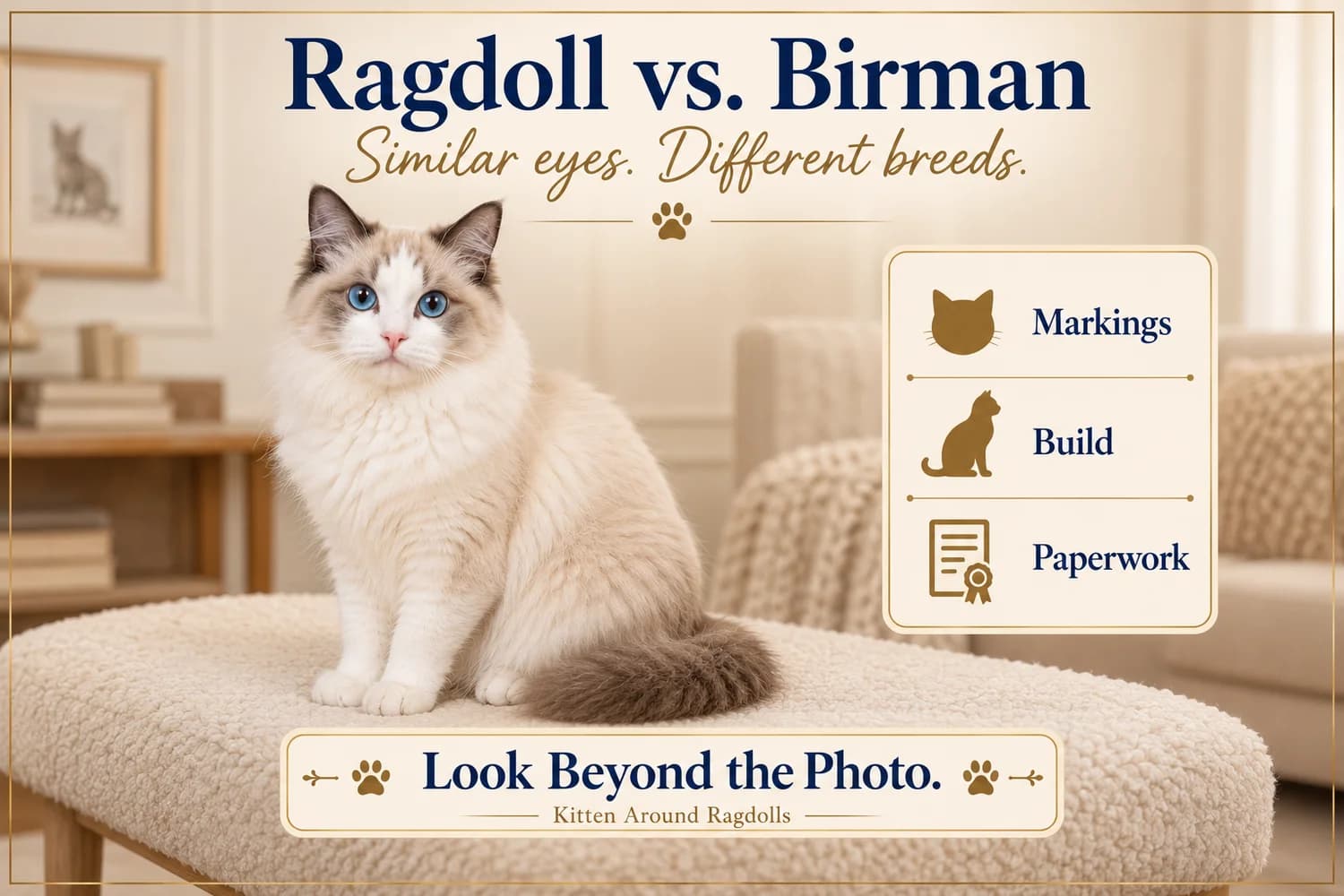
Ragdoll vs. Birman: Similar Blue Eyes, Two Different Breeds

10/17/2026
Male vs. Female Ragdoll Cats: Choose the Individual, Not the Stereotype

10/14/2026
Can Ragdoll Cats Be Left Alone? Planning for Workdays and Real Life

10/12/2026
Buffy’s Ragdoll Lovers Giveaway: Win the Matching Blue Porcelain Set

10/10/2026
Do Ragdoll Cats Shed? A Grooming Routine That Fits Real Life
Subscribe to our newsletter
Kitten availability, cattery updates, and new blog posts — sent when we have news to share.