Ragdoll vs. Birman: Similar Blue Eyes, Two Different Breeds
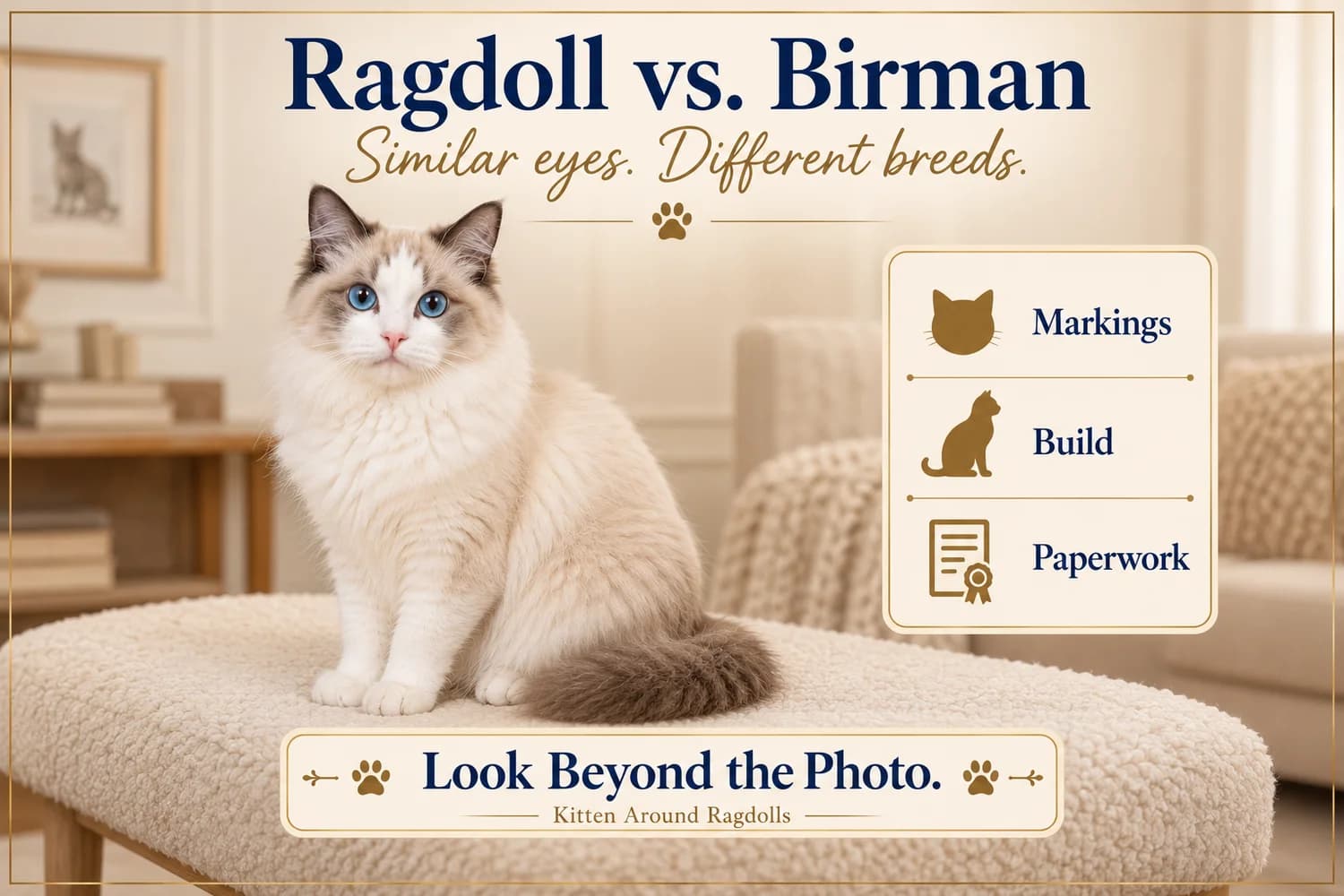
Ragdoll vs. Birman: Similar Blue Eyes, Two Different Breeds
Blue eyes, a soft coat, darker points, and white feet: a quick photograph can make a Birman and a mitted Ragdoll look remarkably similar. They are still two distinct breeds, with their own standards and histories.
If you are comparing Ragdoll vs. Birman for your next companion, start with the features the registries describe, then move to the individual cat. Appearance can narrow your questions. It should not be the only thing making the decision.
The Short Comparison
| Feature | Ragdoll | Birman |
|---|---|---|
| General build | A large cat of moderate type | A medium-to-large, substantial cat |
| Eyes and coloration | Blue eyes and pointed coloration | Blue eyes and pointed coloration |
| White markings | Colorpoint, mitted, and bicolor patterns differ in their white markings | Distinctive white gloves and laces |
| Coat | Semi-longhair; regular care remains important | Semi-longhair; regular care remains important |
| Identification | Registration and pedigree establish the documented breed | Registration and pedigree establish the documented breed |
This is a practical comparison drawn from TICA’s breed descriptions, not a method for assigning a breed to an unknown cat from its appearance.
White Feet Are a Clue, Not a Conclusion
The Birman standard describes white gloves on the feet and laces on the back of the hind legs. A mitted Ragdoll also has white feet, but its pattern is defined differently, including a white chin and belly stripe. A bicolor Ragdoll has a more extensive white pattern, including the inverted V on the face.
Those details explain why two breeds can look similar without being interchangeable. They also explain why a cat with white socks is not automatically either breed. Many wonderful cats have markings that resemble a pedigree breed without having documented ancestry.
Our Ragdoll colors and patterns guide offers a closer look at the Ragdoll side of that comparison.
Adult Size Affects Everyday Equipment
“Large cat” sounds charming until the carrier is too small or the cat tree shifts when the cat jumps onto it. Whatever breed you choose, buy equipment for the adult you expect to live with.
Ask about the parents and the breeder’s observations, while recognizing that no one can guarantee a kitten’s exact adult dimensions. Look at usable carrier space, the stability of a scratching post, and the room available to turn comfortably in a litter box.
A cat’s weight should never become a sales trophy. Comfortable movement and appropriate body condition matter more than achieving a dramatic number on a scale.
Both Breeds Still Need Grooming
A coat described as silky or relatively easy to maintain still needs attention. Find out what grooming the kitten currently accepts, which tools are used, and where the breeder checks for tangles.
Consider whether grooming fits your household in practice. Who will do it? Where will the cat feel comfortable? If someone has hand pain or limited mobility, can the setup be adapted or professional help arranged? Those are useful ownership questions regardless of breed.
Keep sessions gentle and brief, and ask for help if mats become tight or painful. Neither breed label is permission to ignore coat changes.
Temperament Comparisons Have Limits
Both breeds are often described as affectionate companions. That does not establish that every Ragdoll is calmer than every Birman, or that one breed will tolerate any amount of handling. Avoid choosing a cat on a ranking that sounds more precise than the evidence behind it.
Instead, describe your actual household: children, existing animals, work hours, activity, and what companionship means to you. “I want a cat who enjoys sitting nearby while I work” is more useful than “I want the most affectionate breed.”
Ask the breeder what they have observed repeatedly. A kitten’s choices over time tell you more than a single sleepy photograph.
Compare the Breeder as Carefully as the Breed
Once you have found a breed that appeals to you, evaluate the program behind the kitten. Review registration, the written agreement, veterinary records, the actual tests performed, and what happens before go-home.
Do not assume a registry listing is a guarantee about every business practice or future health outcome. Ask specific questions and make sure the answers connect to documents you can review.
Compare what is included rather than treating the lowest initial price as the full cost of ownership. Veterinary care, equipment, food, and backup care continue long after the purchase.
What We Offer
Kitten Around Ragdolls breeds blue-eyed pointed Ragdolls only. We do not breed Birmans. Our kittens are placed in companion homes with no breeding rights, and spay/neuter is completed before go-home.
If a Ragdoll seems like the right fit, our adoption FAQ explains the process, current pricing, payment methods, and visits. Applications are reviewed before reservation; an application alone does not hold a kitten.
If a Birman ultimately suits you better, a careful comparison has done its job. The goal is to choose a companion whose needs you can meet, with accurate information about the cat and the people raising it.
Sources
- TICA: Birman breed information
- TICA: Ragdoll breed information
- Cat Friendly Homes: Routine care and grooming
Related Reading
- Ragdoll Cat Colors and Patterns Explained: Seal, Blue, Bicolor, Mitted & More
- Ragdoll vs. Maine Coon: How to Tell Them Apart
- Ragdoll vs. Siberian: How to Tell Them Apart
Find the Right Ragdoll Companion
Kitten Around Ragdolls raises blue-eyed pointed Ragdolls in Orangevale, California, for companion homes only. Tell us about your household and what you are looking for.
An application does not reserve a kitten or guarantee approval. Please read our current terms.
We are a TICA-registered Ragdoll cattery in the Greater Sacramento Area, serving families in Northern California and beyond. View our available kittens or join our waitlist for updates.
Recent Blogs
10/17/2026
Male vs. Female Ragdoll Cats: Choose the Individual, Not the Stereotype

10/14/2026
Can Ragdoll Cats Be Left Alone? Planning for Workdays and Real Life

10/12/2026
Buffy’s Ragdoll Lovers Giveaway: Win the Matching Blue Porcelain Set
10/10/2026
Do Ragdoll Cats Shed? A Grooming Routine That Fits Real Life
10/07/2026
BEP Ragdolls vs. Cherubim: What the Names Mean Before You Buy
Subscribe to our newsletter
Kitten availability, cattery updates, and new blog posts — sent when we have news to share.