Do Ragdolls Actually Go Limp When You Hold Them? A Breeder’s Honest Answer
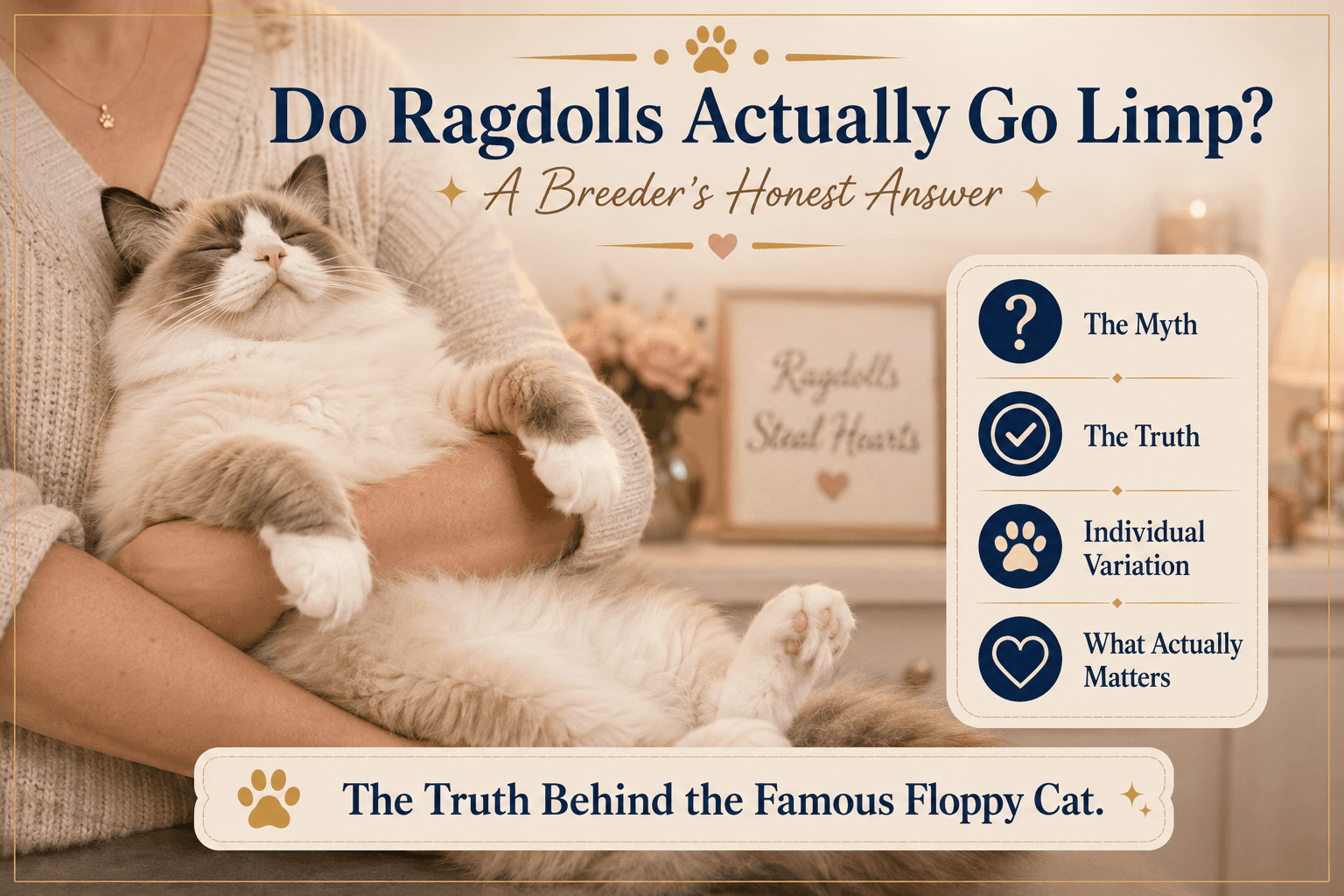
Do Ragdolls Actually Go Limp When You Hold Them? A Breeder’s Honest Answer
If you’ve spent any time researching the Ragdoll breed, you’ve heard it: “They go limp like a ragdoll when you pick them up!” It’s in every breed description. It’s the whole reason for the name. It’s the thing that makes Ragdolls sound like magical stuffed animals in cat form.
But is it actually true?
The short answer: some do, and some do not. The longer answer is more interesting — and much more useful if you’re trying to decide whether to bring one of these cats home.
Let me walk you through what the “flop” actually is, where the myth came from, what it looks like in real life, and what actually makes Ragdolls special (spoiler: it’s not just the flop).
Where the “Ragdoll” Name Came From
The breed was developed by Ann Baker in California in the 1960s. The name is associated with relaxed handling, but it is not a test every Ragdoll must pass. CFA’s breed history separates that history from expectations for an individual cat.
What “Going Limp” Actually Looks Like
Some Ragdolls relax into a supported cuddle; others would rather sit beside you. Support the chest and hindquarters, keep handling gentle, and put the cat down if they want to leave. Please do not turn a cat upside down or move their limbs to test the flop. Stillness alone does not establish comfort.
That lovely relaxed cuddle can be real without being a promise about every cat. Ragdolls feel pain and need the same respectful handling as other cats.
But Here’s the Nuance…
Not every Ragdoll flops the same way. In fact, individual variation within the breed is huge. Some Ragdolls are extremely floppy. Some are only moderately floppy. Some barely flop at all.
What determines how “floppy” an individual Ragdoll will be?
1. Their Individual Personality
Ragdolls are bred for calm temperament, but individual cats still vary. Some are extremely laid-back extroverts (like our own Twilight Sparkle, who’s floppy to an extreme degree). Some are more energetic and less patient with being held. Some are affectionate but prefer to sit on you rather than be picked up.
Personality is genetic, but not perfectly predictable. Two littermates can have very different levels of floppiness.
2. Their Socialization
We spend time gently handling our kittens and making human contact a positive experience. Socialization supports confidence; it does not guarantee a particular adult handling style.
3. Their Age
Kittens have exploring to do, and preferences may change as they mature. There is no deadline at which a kitten must become floppy, and no reason to force it.
4. Their Comfort in the Moment
Consider the whole cat and the situation. A familiar environment, gentle support and the freedom to leave matter more than achieving a pose. A sudden change in willingness to be touched can also deserve a veterinary check. Merck Veterinary Manual’s feline behavior guidance discusses fear, pain and handling concerns.
What Actually Makes Ragdolls Special (Beyond the Flop)
Here’s what I wish more Ragdoll marketing focused on: the flop is just one visible expression of a much bigger truth about the breed. Ragdolls are unique because they were selectively bred to be affectionate companions with a gentle reputation.
What this actually looks like in daily life:
They Follow You From Room to Room
Ragdolls want to be with you. If you move to the kitchen, they follow. If you go to the bathroom, they may camp outside the door. If you sit on the couch, they sit with you. This “dog-like” trait is much more consistent across the breed than the flop.
They Still Need Boundaries
A gentle reputation is not permission to hold a cat in uncomfortable positions or ignore their signals. Supervise children, teach supported handling, and give the cat a way to leave. Any cat can bite or scratch when frightened, hurt or overwhelmed.
They Bond Deeply
Ragdolls form deep, lifelong bonds with their people. They notice when you’re sad. They celebrate when you come home. They stay by your side when you’re sick. The bond is emotional, not just physical.
They Vocalize Softly
Ragdolls tend to have quiet voices — soft chirps and trills rather than loud demanding meows. They communicate, but not disruptively. Great for apartment living or households with sound sensitivity.
They Play Gently
Play is still cat play. Use appropriate toys, keep hands out of chasing games, and guide children through calm interactions.
So Why Do People Sometimes Say Their Ragdoll Isn’t Floppy?
Because individual cats have individual preferences. A Ragdoll who does not enjoy being carried is not automatically a mix or poorly socialized. Pedigree and registration records establish ancestry; a handling test does not. An affectionate cat may prefer company beside you rather than in your arms.
Should You Buy a Ragdoll Just for the Flop?
Honestly? No. Buy a Ragdoll for the whole package — the affectionate temperament, the intelligence, the beauty, the bond. If your cat enjoys a relaxed cuddle too, it’s a wonderful bonus.
If flop is your only criteria, you might be disappointed if you get a less-floppy individual cat. And you’d be missing what actually makes the breed special — a companion animal who is genuinely bred to love being with humans.
How to Tell If a Kitten Will Be Floppy as an Adult
We can share what we observe about each kitten now, but eye contact, belly exposure or cuddling a sibling cannot guarantee adult floppiness. Tell us about your household and the companionship you hope for. Thoughtful matching means respecting the kitten in front of us, not promising a future pose.
The Real Answer
Some Ragdolls enjoy that famous relaxed cuddle; others show affection differently. Neither response makes a cat more or less worthy of the name. The bond matters more than the flop.
Come Experience It for Yourself
Nothing describes the Ragdoll flop like actually experiencing it. If you’d like to meet our cats or discuss whether a Ragdoll is right for your household, please reach out.
🐾 Ready to Meet a Real Ragdoll?
Meet the individual kitten, ask about temperament, and plan a thoughtful match. See our available kittens or join our waitlist for upcoming litters.
Looking to bring home a real Ragdoll from a real TICA-registered breeder? Check our available kittens or join our waitlist for upcoming litters. We’re a TICA-registered cattery in Sacramento, CA, breeding for health, temperament, and the traditional Ragdoll standard.
Recent Blogs
11/14/2026
Leaving Your Ragdoll at Home for the Holidays: A Pet-Sitter Checklist
11/11/2026
Ragdoll Cat Lifespan: What the Research Says and How to Plan for the Years Ahead

11/07/2026
Persian Cat vs. Ragdoll: Which Companion Fits Your Home?
11/07/2026
Carrier Training a Ragdoll Cat: Make the Carrier Part of Home
11/04/2026
Do Ragdoll Cats Scratch Furniture? Give the Behavior a Better Place to Go
11/02/2026
Bringing a Ragdoll Kitten Home to Oregon: A Pickup and Paperwork Checklist
Subscribe to our newsletter
Kitten availability, cattery updates, and new blog posts — sent when we have news to share.