Ragdoll Allergy-Friendly Diets: Why We’re Removing Chicken and Fish From Our Cattery — And What We’re Feeding Instead
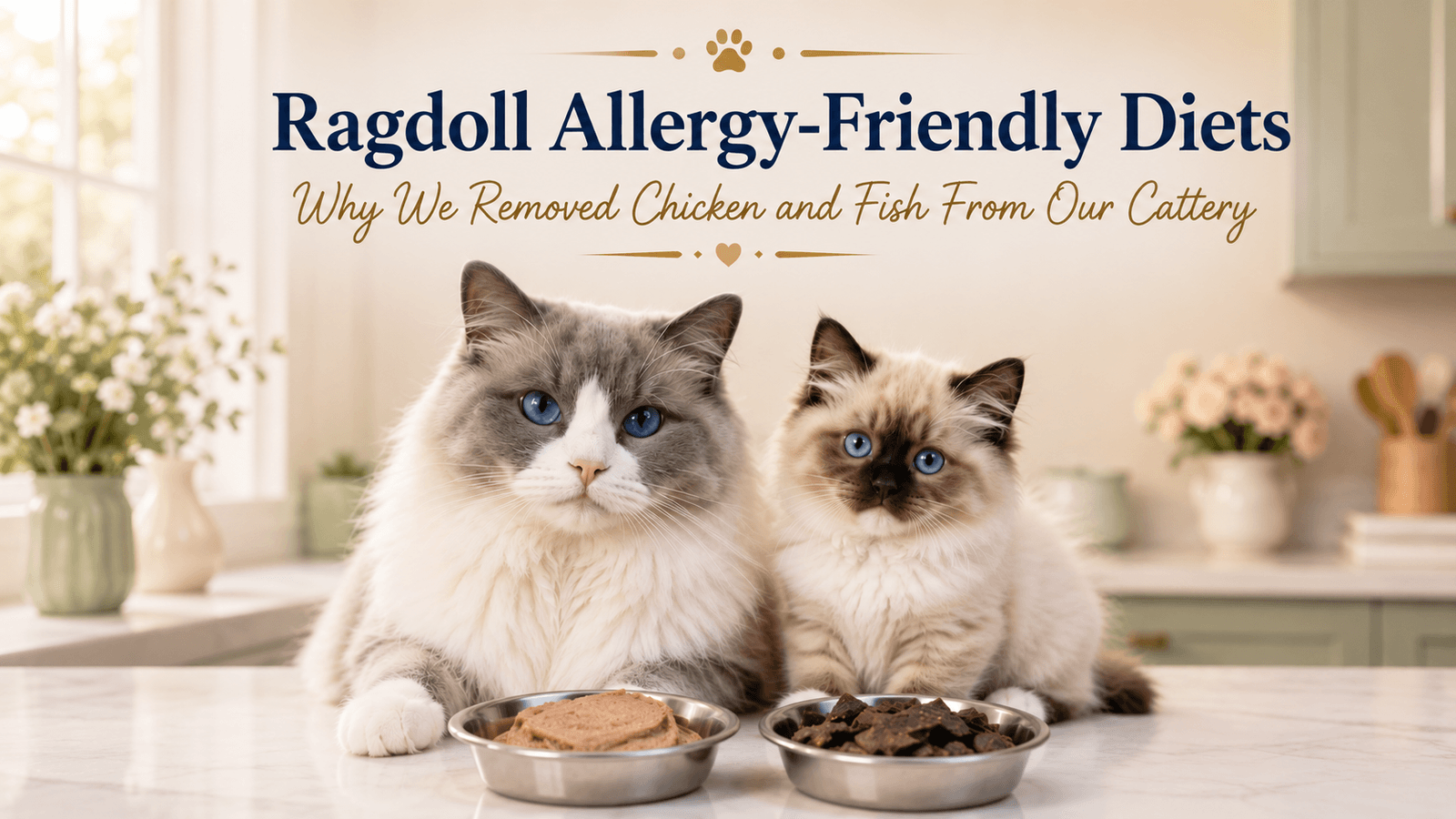
This post is for two groups of people at the same time.
If you are a prospective buyer evaluating our program, this is a look at how a health decision actually gets made here — from the data we collect, through the research we run, to the concrete changes we implement across the whole household. You are seeing our commitment to health in real time, not as marketing language.
If you are an existing owner of one of our cats, or of any cat, this is practical, actionable information about food, treats and supplements that you can bring to your own vet and use in your own kitchen. Every cat is different, and your veterinarian knows yours — but this is the framework we use, and it is worth thinking about even if you land somewhere different than we did.
Either way, welcome. This one is long because it needs to be. Health decisions deserve the whole picture.
The short version
We are removing chicken, fish, beef and egg from our cattery entirely. Not just for cats with symptoms — for every cat and kitten in the house. This is part of our ongoing commitment to health, driven by real data from our annual owner survey and by our own research into the products we can trust.
The rest of this post explains why, exactly what we are feeding instead, how we chose it, what to watch for in your own cat, and how to switch safely if you decide to do the same.
What the survey actually told us
Every year I send a health and diet survey to every family who has taken a kitten home from us. Weight, food, litter, body condition, any health issue, and an overall health score. Healthy answers as well as worrying ones — the healthy answers are the ones that tell me whether a pattern is real or just a coincidence.
The last round covered twenty-five cats from litters going back to 2022. Seventeen of the twenty-five cats had some digestive history. Most of it was mild and long resolved. But a real share of it was ongoing, and when I sorted the answers by what people had actually changed to fix it, eight households across seven different homes and five years of litters had independently arrived at the same conclusion: reduce the irritant and move to a simpler, gentler food.
Different cats. Different vets. Different states. Same answer, reached separately.
Two specific things pointed straight at us:
- A freeze-dried whole fish treat we were sending home in our go-home bags. One household with two of our cats reported that both developed diarrhea on it and both recovered when the treats stopped. Three other households independently described loose stool tied to rich freeze-dried protein treats. That treat is gone from our bags.
- The kitten food we had been sending home. Of the cats fed the grain-free kitten formula we were using at the transition, most had loose stools in their first weeks. The two who did well were on a different formula in that line, or on the wet food only. That is not a claim that the food is bad — it is a claim that the food we chose was not working for our kittens, which is a much more useful thing to be able to say.
Alongside that, several cats had itching, over-grooming, watery eyes or recurring ear trouble — the skin and ear side of food sensitivity that owners often do not connect to the bowl at all.
You can read the full breakdown of the survey and what else it taught us in our 2026 owner health survey results post. What is below is the food-specific action we took because of it.
Chicken, fish, beef and egg: the four we are taking out
In cats, adverse food reactions are most often reported to a small handful of proteins, and the same names come up again and again in the veterinary dermatology literature: beef, fish, chicken, dairy and egg.
There is nothing mysterious about why. A protein has to be eaten repeatedly before the immune system has the chance to react to it, and chicken and fish are in almost everything a cat eats in this country — the kibble, the wet food, the treats, the dental chews, the flavoring in a liquid medication. A cat who has eaten chicken every day of its life has had thousands of opportunities to develop a reaction to chicken. A cat who has never eaten venison has had none.
Beef and egg are on our list for the same reason even though they come up less often in cat food than chicken does. Both are among the most commonly reported feline food allergens, and there is no reason for us to leave known common triggers in the bowl when we are going to the trouble of clearing the others out. Egg in particular hides in places you would not expect — it turns up as a binder in wet foods and as “dried egg product” partway down a kibble panel on bags whose front says something else entirely.
It is worth being precise about one thing: a true food allergy is an immune reaction, and it is not the same as a food intolerance, where a cat simply does not digest something well. From the outside they look nearly identical — loose stool, gas, vomiting, itching. The only way to tell them apart properly is a strict elimination trial run by a vet. What we are doing here is not a diagnosis. It is removing the most likely triggers from the whole house so that fewer cats ever need one.
What vets usually recommend, and why they recommend it
If you ask most veterinarians what to feed a cat, you will hear the same short list: Hill’s, Royal Canin, Purina Pro Plan. I want to be fair about why, because the reasoning behind that advice is genuinely good and it is not just habit or a display shelf in the lobby.
Those companies do several things that most boutique brands do not:
- They employ full-time board-certified veterinary nutritionists who formulate the diets.
- They run AAFCO feeding trials — actually feeding the diet to cats and measuring outcomes — rather than only formulating on paper to hit a nutrient profile.
- They own and control their own manufacturing plants, rather than contracting production out.
- They fund and publish peer-reviewed research, and they have decades of data behind their formulas.
Those are the questions the World Small Animal Veterinary Association tells owners to ask about any pet food company, and they are the right questions. If your vet has recommended one of those brands to you, they had good reasons.
Why we went a different direction anyway
Here is our problem, and it is a narrow one.
Nearly every one of those maintenance formulas is built on chicken, chicken by-product meal, or fish. The exact proteins we are trying to clear out of the building. Excellent quality control on a chicken-based food does not help a cat who reacts to chicken.
The answer that world offers for a reacting cat is a prescription hydrolyzed protein or novel protein diet — a therapeutic food where the protein is broken into fragments too small for the immune system to recognize. Those diets work, they are well made, and if your vet puts your cat on one, that is a good decision and this post is not an argument against it.
But a prescription diet is a treatment. It requires a diagnosis, a script, and a cat who already has a problem. We would rather not produce the problem.
What we needed was a food that:
- contains no chicken, no fish, no beef, no egg
- is complete and balanced for all life stages, so the same food feeds nursing queens, weaning kittens and adult cats without swapping formulas
- any family can buy without a prescription, anywhere in the country
- is built on whole meats and organs rather than by-product meals and grain fillers
One honest trade-off, since I would rather say it than have you find it: the boutique brands we landed on generally do not run the feeding trials the big three do, and grain-free diets have drawn scrutiny in dogs over taurine and heart disease. We took that seriously. Every food on our list is meat-based rather than legume-heavy, carries added taurine, and states an AAFCO nutritional adequacy claim on the label. Talk to your vet about your own cat — that is not a decision I can make for you from a blog post.
How we actually chose these foods
I did not pick these off a shelf. This took weeks, and I want to be transparent about the process because I think it is the part most people skip.
For every brand on the shortlist, I worked through:
- Full recall history — every recall, what caused it, how the company responded, and whether it was voluntary or FDA-forced. Some well-marketed brands got eliminated at this stage. Recall history alone knocked several otherwise-promising options off our list.
- Years in business and ownership — who owns the brand now, whether it has been acquired, and whether the formula changed after an acquisition.
- Where it is manufactured, and whether the company controls that facility.
- The complete ingredient panel of every single formula, read line by line — not the marketing copy on the front of the bag. This is where most “limited ingredient” foods fall apart. A rabbit food with fish oil in it is not a fish-free food.
- The AAFCO nutritional adequacy statement on every bag and can. This one matters enormously and almost nobody reads it. A food labeled for maintenance is formulated for adult cats. A food labeled for all life stages is the only kind you can safely feed a growing kitten or a nursing queen. One of the foods we tested and liked turned out to be maintenance-only, which is exactly why it appears on our adult list below and not our kitten list.
I ran the same questions through several different AI research models and compared their answers against each other and against the manufacturers’ own published labels, because any single source — including a confident one — can be wrong or out of date. Where the models disagreed, I went to the label. The label always won.
That cross-checking is also how we caught something we had missed entirely: one of the most commonly recommended feline probiotics — one we had been using ourselves — contains a palatant derived from hydrolyzed pork and poultry liver. We had been about to eliminate poultry from every bowl in the house while sprinkling poultry on top of the food every day. It is nowhere on the front of the packet. We have removed it from our protocol. More on that below.
A second reason to drop freeze-dried poultry that has nothing to do with allergies
This one caught us by surprise, and it is worth its own section because it applies to every cat owner feeding freeze-dried raw, allergy or no allergy.
Freeze-drying is not a kill step. It removes water, which stops bacteria from multiplying, but it does not reliably inactivate viruses the way cooking does. That is fine for most pathogens most of the time — it is why freeze-dried raw has a good safety record overall — but highly pathogenic avian influenza (H5N1) has been circulating in poultry flocks, and cats are unusually susceptible to it. There have been raw pet food recalls tied to it, and infections in cats have been severe.
The risk to any individual cat eating a commercial freeze-dried poultry product is low. I want to be clear about that rather than frightening anyone. But it is a risk that rabbit, venison and lamb simply do not carry, because the virus is a bird virus.
So when we sat down to pick a freeze-dried food, the poultry options were carrying two separate problems at once: chicken is the most commonly reported feline food allergen, and poultry is the one protein family with an active avian influenza concern. Rabbit and venison have neither. Once we saw it laid out that way, the decision made itself.
What we are feeding: kittens, weaning and nursing queens
These are all labeled complete and balanced for all life stages, which is what makes them safe for growing kittens and for queens in pregnancy and lactation.
Everything below is available in our Amazon storefront in the Food, Treats & Supplements collection, so you can see the exact products we buy without hunting through the aisles.
ZIWI Peak Air-Dried Venison — our shelf-stable, free-choice food
Ragdolls in our home are free-fed, and a wet-only diet does not allow that. ZIWI’s air-dried venison is 96% venison meat, organs, bone and cartilage, plus New Zealand green mussel and organic kelp. Air-dried rather than baked, so it behaves like a raw diet on the shelf without the handling risk. Ingredient panel here.
Two honest notes: it contains New Zealand green mussel, which is a shellfish. It is not finfish, and in our experience it has not been a problem — but if your cat is being run through a strict single-protein elimination trial by your vet, mention it. It also contains kelp, which is seaweed rather than fish.
ZIWI Peak canned Venison, and Rabbit & Lamb
Both are all-life-stages and both give us rotation without introducing a new protein family. They use chickpeas as a binder instead of gums.
ZIWI Peak Air-Dried Lamb
Lamb is our third safe protein and gives kittens some variety in texture and taste before they go home, which makes them less likely to be difficult eaters later.
Kittens leaving here will be eating both the rabbit pâté and the air-dried venison — a high-moisture diet plus a dry-textured food — and both go home in the go-home bag. That means new families are not switching anything in the first week, which is the single biggest cause of the loose stool that shows up in survey answers year after year.
Our Buffy the Vampire Slayer litter, born in July, is the first litter here to be raised entirely poultry- and fish-free from weaning. They will go home in late October on ZIWI, having never eaten chicken or fish in their lives. That is a first for us, and it is the group we will be watching most closely.
One honest word about cost
ZIWI is expensive. There is no way around that and I am not going to pretend otherwise — it is several times the price per pound of a mainstream kibble, and for a household with several cats that is a real number.
We have decided to absorb it in the nursery, because weaning kittens and nursing queens are where it matters most and where the amounts are smallest. For adult cats, the rabbit kibble is far more economical and does the same job on the protein question. If you are feeding a multi-cat household, that split is a reasonable one to copy: the good stuff where the growth is happening, the sustainable option for the adults.
What we are feeding: adult cats
We run two tiers here deliberately. Our adults eat a different food from our kittens, our pregnant queens and our nursing mothers — the nursery group stays on the all-life-stages foods above, and our adult cats have their own kibble and wet food. Everything in the previous section is also appropriate for adults; this is what we add for them.
Instinct Limited Ingredient Diet Real Rabbit — wet food
A single-protein rabbit wet food that pairs directly with the Instinct kibble below, so an adult cat can be on rabbit across both wet and dry without introducing anything new. Useful for rotation, and useful if you have an adult who does better on higher moisture.
Instinct Limited Ingredient Diet Real Rabbit — kibble
One animal protein and one vegetable, made without chicken, beef, fish, dairy, eggs, grain, potato, corn, wheat or soy. Full ingredient list here.
Read this part carefully: this kibble’s AAFCO statement is for maintenance, not all life stages. It is an excellent, cost-effective adult food and that is exactly how we use it. It is not a kitten food and should never be the main diet of a growing kitten, a pregnant queen or a nursing mother. This is precisely the label check I described above, and it is the reason this food sits in the adult section rather than the nursery one.
If you take one practical thing away from this whole post, make it this: turn the bag over and read the AAFCO nutritional adequacy statement before you buy. “Maintenance” means adult cats. “All life stages” means everybody. It is one sentence in small print on the back panel and it tells you more than the entire front of the bag.
Treats
Treats are where good diets quietly fall apart. One fish treat undoes a month of careful feeding.
Our rule now is simple: rabbit, venison or lamb only. No poultry. No fish. No beef. No egg.
The two treats we currently use and recommend, both single-protein and both stocked in our Amazon storefront:
- Fresh Is Best freeze-dried rabbit — buy through our affiliate link with code KITTENAROUND15 for 15% off. Single-ingredient rabbit, nothing else.
- Fresh Is Best freeze-dried venison bites — same brand, second safe protein for rotation.
What we are not using any more is Fresh Is Best’s chicken, and that is a change for us — their freeze-dried chicken used to be our kittens’ first solid food, and we recommended it here for years. It is a good product. It is simply the wrong protein for us now, for both of the reasons above.
We are also not using their rabbit food, and I want to explain why because it is the single best illustration in this whole post of reading labels rather than front-of-bag claims: their rabbit formula contains fish. That is a perfectly reasonable formulation choice for most cats. It just is not compatible with what we are doing. The treats are fine. The food is not, for us.
This happens constantly once you start looking. During this research I went through a lamb-labeled limited-ingredient food and found fish meals sitting at the second and third ingredient positions — behind a bag that says lamb. Another whole product line I had short-listed turned out to have chicken in every single formula, including the ones named after something else. Another had a recall history that took it off our list before I even reached the ingredient panel. The front of the bag is marketing. The ingredient panel is the product.
The same rule applies to anything else that goes in your cat’s mouth: dental treats, lickable tubes, food toppers, flavored liquid medications, probiotic powders, and the other cat’s bowl.
A word on rich organ-meat treats
Even within the safe proteins, we do not recommend or feed rich freeze-dried organ-meat treats to Ragdolls. Ragdoll stomachs can be sensitive, and organ meat is far richer than muscle meat — even a single treat of pure liver or heart can cause loose stool in a cat who is otherwise doing fine. If a treat is labeled as an organ meat, look for products that combine organ with muscle meat rather than serving organ alone.
Gut support: probiotics and vitamin B12
Diet is most of this, but not all of it.
Probiotics — and the one we have stopped using
Our entire household stays on a probiotic — through weaning, through go-home, and we ask families to continue it. It is inexpensive and it is the closest thing there is to insurance on a stressful transition.
The two most veterinarians reach for are Proviable and FortiFlora. We had been using both. We have now removed FortiFlora from our cattery entirely, and it is worth explaining why, because I doubt we are the only household this applies to.
FortiFlora’s flavoring — listed as animal digest, and renamed “liver flavor” on more recent packaging — is derived from hydrolyzed pork and poultry liver. It is a fine product and there is nothing wrong with it for the vast majority of cats. But we were about to strip poultry out of every bowl in the house while sprinkling a poultry-derived powder on top of the food twice a day. That is not a small inconsistency. It is the kind of thing that quietly ruins an elimination diet and leaves you concluding that the food change did not work.
We now use Nutramax Proviable — a multi-strain probiotic with added prebiotic and no poultry-derived flavoring. Stocked in our Amazon storefront.
With one important detail, which we only found by digging: the Proviable capsule shell is gelatin, and the manufacturer does not disclose which animal it comes from. It is most likely bovine or porcine. The powder inside the capsule is clean — prebiotics, the bacterial cultures, and a few carriers, with no named animal protein — but the shell itself is an unknown.
The fix is easy and it is how most people end up giving this to a cat anyway: open the capsule, sprinkle the powder over the food, and throw the shell away. Your cat gets the probiotic and none of the gelatin. If your vet has you on the Proviable paste rather than the capsules, that is a different formulation and worth checking separately.
I mention it not because I think a gelatin capsule shell is going to harm a cat — it almost certainly will not — but because it is a perfect example of how far down you have to read. Four ingredients into a supplement nobody would think twice about, and there is an undisclosed animal-derived component.
If your cat is on FortiFlora and doing beautifully, this is not a reason to panic or to change anything. But if you are eliminating poultry, or if you have been trying a diet change that has not produced the result you expected, this is worth raising with your vet. Read the inactive ingredients on any supplement, topper or dental treat you are giving. The front of the box will not tell you.
While you are at it, read your supplements too
Going through our own shelf was humbling. A few things we pulled, and why, in case the same bottles are in your cupboard:
- An immune supplement we had been using turned out to get its DHA and EPA from marine lipids. The manufacturer names no non-fish source, so it has to be treated as fish-derived. Out.
- Our hairball gel is tuna flavored — tuna is right there in the formula. The maple-flavored version of the same product still lists unspecified gelatin by-products and artificial flavors, so that is not a fix either. Out. For hairballs we are using unflavored psyllium fiber, plain pumpkin, and more brushing instead.
- Flavored liquid medications from the pharmacy. Compounded meds are very often flavored with chicken or fish because that is what cats will take. If your cat is on anything liquid, ask the pharmacy what the flavoring is.
Topical flea and tick products are a different case. They are not eaten, and most manufacturers disclose only the active ingredient, listing the rest as “other ingredients” — so a full allergen read simply is not possible on them. We are keeping ours — we currently use Cheristin for Cats, also in our storefront — and treating it as its own category rather than pretending it has been cleared.
Vitamin B12
This is the one most owners have never heard of. Cats with ongoing intestinal inflammation frequently become deficient in cobalamin (vitamin B12), because B12 is absorbed in the last section of the small intestine — precisely the part that stops working properly in chronic GI disease. And low B12 makes the gut work worse, which lowers B12 further.
Breaking that loop with B12 supplementation, usually given by injection, is standard supportive care for cats with chronic digestive problems, and it can make a real difference to appetite, weight and stool quality alongside the diet change. It requires a vet: they will check the level, decide whether it is warranted, and determine the schedule. Do not attempt this at home, and please do not ask me for amounts — that is a conversation for your veterinarian, not your breeder.
Why we are not going the hydrolyzed protein route
The conventional path for a cat with suspected food allergy is: symptoms appear, the cat gets worked up, the vet prescribes a hydrolyzed or novel-protein therapeutic diet, and the family manages it from there. That path works and there is nothing wrong with it.
We are doing something different, and the logic is simple.
Across twenty-five surveyed cats, not one had ever completed a properly run elimination trial. Not one. Families tried things, changed foods, improved somewhat, and stopped short of an answer. A real trial is eight to twelve weeks of a single protein with absolutely zero exceptions, followed by a deliberate rechallenge, and almost nobody manages it — someone lets a treat through in week three, and the whole thing is uninterpretable.
So rather than wait for cats to develop problems and then ask their families to run a trial that statistically will not get finished, we are moving every cat here onto proteins we already know work, whether that individual cat has symptoms or not.
A healthy cat eating rabbit and venison instead of chicken loses nothing. There is no downside for the cat who was fine either way. But the cat who would have reacted never gets the chance to, and the kitten who goes home already eating this way never has the miserable first three months that show up in survey answers.
It is prevention instead of treatment, applied to everyone. That is the whole idea, and it is a core part of our ongoing commitment to health.
What to watch for in your own cat
If any of this sounds familiar, it is worth a conversation with your vet — and if your cat is one of ours, I would like to hear about it too, because it goes into next year’s data.
- Stool that is regularly soft, unformed or urgent — not one bad day, but a pattern
- Mucus or any blood in the stool
- Vomiting more than genuinely occasional hairballs — weekly vomiting is not normal, even in a cat who seems otherwise fine
- Itching, over-grooming, or thinning fur, especially around the head, neck and belly
- Watery eyes or persistent sneezing
- Recurring ear infections or head-shaking
- Excessive gas
- Weight loss, or a young cat who is not gaining
One practical note on assessing condition: use your hands, not just your eyes. A Ragdoll coat hides a great deal. Run your fingers along the ribs — you want to feel them under a thin layer without pressing hard — and then look down at your cat from above while they are standing.
How to switch without causing the problem you are trying to fix
If you decide to move your cat onto a chicken free cat food, do it slowly. A fast switch produces exactly the loose stool you were trying to prevent, and then nobody can tell whether the new food failed or the transition did.
- Take two full weeks. A quarter new to three quarters old for four days, then half and half, then three quarters, then all new.
- If stools soften, drop back a step and hold there longer. Do not push through it.
- Change one thing at a time. Not the food and the litter and the treats in the same week.
- Clear out everything else first. Treats, toppers, dental chews, flavored medications. If chicken is still coming in through a treat, the diet change tells you nothing.
- In a multi-cat home, everybody switches. Cats eat out of each other’s bowls, and one shared bowl invalidates the whole experiment.
- Give it eight weeks before you judge it. Skin and coat changes in particular are slow — you will not see them in ten days.
Our ongoing commitment to health
This post is not a one-time announcement. It is what one round of our annual owner survey produced. There will be another round next year, and another the year after that, and we will keep publishing what we learn — including the parts that are inconvenient for us.
That is what “ongoing commitment to health” actually looks like in practice: real data collected from real families, cross-referenced against the research, translated into concrete changes across the whole household, and shared openly whether the news is flattering or not.
If you are a prospective buyer, this is what you are choosing when you choose us — not a static breeder who set their protocol in stone years ago, but a program that is genuinely learning and adapting from year to year based on how our kittens actually do in your homes.
If you are an existing owner, thank you for being part of the data that made this change happen. And please keep telling us the truth about your cat. It is how we get better.
Thank you
None of this exists without the families who filled out the survey. I know a form in your inbox is easy to ignore, and I know some of you filled it in for a cat who is perfectly healthy and probably wondered why I needed to hear from you at all. You are the reason the rest of the answers mean anything.
Something else came through in those responses that I did not expect and will not forget: almost every single person, unprompted, wrote about how much they love their cat. Across the board. Different households, different states, different years — the same sentence over and over, in different words. That is the actual point of all of this, and reading it was the best afternoon I have had in a long time.
If you have questions, suggestions, or something you think we have got wrong, please tell us. If your cat is struggling, please reach out. We are here for the life of your cat, and that is not a marketing line.
Related Reading
- Our First Annual Ragdoll Owner Health Survey — What We Learned
- How We Ensure Every Ragdoll Kitten Is Healthy
- Comprehensive Health Testing on Every Ragdoll Kitten
🐾 Considering a Kitten From a Cattery Committed to Learning?
Our program keeps adapting based on real data from our owner families. See our available kittens or join our waitlist for upcoming litters.
This article is educational and reflects the feeding decisions we have made for our own cattery. It is not veterinary advice. Every cat is different — please talk to your veterinarian before changing your cat’s diet, starting a supplement, or acting on anything here, especially if your cat has ongoing symptoms.
This post contains affiliate links. If you buy through them we may earn a small commission at no extra cost to you. We only ever link to products we actually use in our own home.
Recent Blogs
09/26/2026
Who You Buy From Matters More Than You Think
09/23/2026
What Ragdoll Health Testing Actually Includes: A Complete Guide
09/21/2026
Why Cheap Ragdoll Kittens Are Actually Expensive: A Breeder’s Warning
09/12/2026
What’s Included When You Buy a Ragdoll Kitten From Us

09/09/2026
What Our Past Buyers Just Told Us About Their Cats — And What We Changed Because of It
09/05/2026
How to Read a Ragdoll Breeder’s Health Testing (What Documentation Should Actually Look Like)
Subscribe to our newsletter
Litter announcements, new posts, and the occasional discount — no spam.